
Uniform Commercial Code filings create a public record of secured lending in South Carolina. The Secretary of State maintains the central index for financing statements filed under Revised Article 9. Lenders, buyers, and borrowers use that index to trace claims against collateral. A UCC search report lists the records that match the name submitted, but it does not establish whether a debt exists or remains unpaid.
The index is separate from the business entity records that show corporations and limited liability companies. A filing may name an individual, a company, or another organization as debtor. The office assigns a file number and records the secured party and collateral description. Requests for copies, certifications, and search results follow the fee schedule published by the agency.
The UCC Index and Its Purpose
The index gives notice that a secured party claims an interest in collateral described in a filing. A South Carolina company search covers entity registration, while the UCC system covers financing statements. The two records can be checked together when a transaction involves a business borrower. Neither record resolves ownership disputes or confirms that collateral exists.
Public Notice Function
A financing statement puts later creditors and buyers on notice that a prior claim may exist. The filing does not transfer title or create a debt by itself. It preserves the secured party’s place in the filing order, which can affect priority under Article 9. The public can inspect the record without obtaining the debtor’s consent.
What the Index Does Not Decide
The presence of a filing does not prove that the underlying loan was made or that money remains owed. It also does not prove that the collateral description is accurate or that the secured party perfected its interest. A party must examine the transaction documents and applicable law before drawing a conclusion about priority or default.
South Carolina Secretary of State, UCC search system:
https://ucconline.sc.gov/UCCFiling/UCCMainPage.aspx
The Central Filing Office
The South Carolina Secretary of State is the central filing office for financing statements under Revised Article 9 of the Uniform Commercial Code. Filings that belong at the state level are submitted to that office rather than to a county register. The office indexes the records and makes them available through its UCC search system. The agency also handles requests for copies and certification.
Statutory Authority
Revised Article 9 governs secured transactions and sets the rules for filing, searching, and priority. The statute determines which office receives a financing statement and how long it remains effective. Agency procedures implement those requirements but cannot extend a filing beyond the statutory period. A filer should review the current statute and office instructions before submitting a record.
Records Held at the State Level
Financing statements for most commercial debtors are held in the official statewide system. The central office receives the filings that the statute assigns to it. A filer should first confirm the correct office before submitting a UCC-1. A search of the state index alone may not reveal a record properly filed with a different authority.
What a UCC-1 Contains
The UCC-1 is the initial financing statement used to give public notice of a security interest. It identifies the debtor, the secured party, and the collateral covered by the security agreement. Those three elements connect the public record to the lending transaction. A complete record helps later searchers locate the filing under the correct names and review the claimed collateral.
Debtor Identification
The debtor’s name must be stated according to the statute’s naming rules. An organization uses its registered name, while an individual uses a personal name as required by the form. An incorrect debtor name can weaken the filing’s effectiveness or cause a search to miss it. The filer should compare the name with official records before submission.
Secured Party Information
The secured party is the lender or other person holding the security interest. The filing states that party’s name and address, and an assignee may later be added through an amendment. The record does not list every participant in a loan syndicate. A searcher should read later filings to identify any assignment or change of secured party.
Collateral Description
The collateral description must reasonably identify the property covered by the security agreement. A filing may describe categories such as inventory, equipment, accounts, or a specific item. The description need not be exhaustive, but an unclear or overly narrow statement can limit what the record covers. The security agreement itself controls the parties’ actual rights.
The Five-Year Lapse
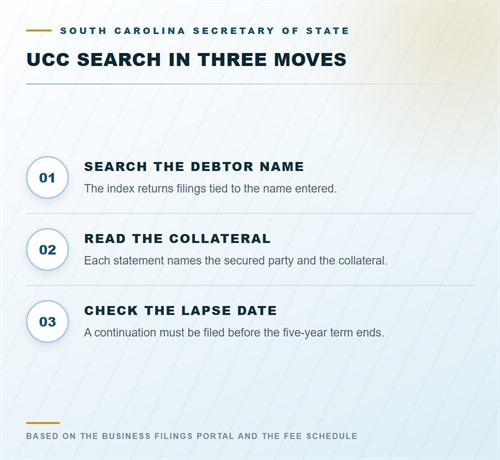
A UCC-1 lapses after five years unless the secured party files a continuation. The lapse date is calculated from the date the initial financing statement was filed. After lapse, the filing ceases to be effective as notice, and the secured party may lose priority. A continued filing remains in the index only if the office accepts the continuation before that deadline.
Calculating the Lapse Date
The office records the initial filing date, and the lapse date follows from that entry. A filer should not rely on the date of a related loan or the date the debtor signed the agreement. The file number and initial filing date should be checked on the search report. A continuation filed too early or too late may not preserve the record.
Effect of Lapse
Once a filing lapses, it no longer provides constructive notice to later creditors. The secured party may need to file a new financing statement, which can produce a different priority position. A lapse does not erase the underlying contract or debt. It affects the public record and the statutory consequences that follow from that record.
Continuation With a UCC-3
A UCC-3 can continue an effective financing statement for another five years. The continuation must be filed within six months before the lapse date. The office links the continuation to the original file number, so the filer should provide that number accurately. A continuation does not create a new filing date or restore a record that has already lapsed.
The Six-Month Window
The statutory window opens six months before the lapse date and closes on that date. A filing submitted outside the window may be rejected or may fail to continue the original record. The secured party should calendar the deadline and confirm receipt by the office. Mailing a continuation close to the deadline carries serious delivery risk.
Filing and Acceptance
The office reviews the continuation for current required information and accepts it into the index. The continuation should identify the original financing statement by its specific file number. Errors in that number can prevent the office from matching the two records. A continuation has no effect unless the original filing remains effective on the date it is filed.
Missed Deadlines
A secured party that misses the continuation deadline may lose the benefit of the original filing date. A new UCC-1 can be submitted, but it will not relate back to the earlier record. The debtor and other creditors may gain a different priority position. The lapse date should be tracked well before the window opens.
Amendment, Termination, and Assignment
The same UCC-3 form can amend, terminate, or assign a financing statement. An amendment changes information such as the debtor name, collateral, or secured party address. A termination ends the effectiveness of the filing for future notice. An assignment transfers the secured party’s interest to another person. The office indexes each event against the original record.
Changing the Record
An amendment should identify the specific original filing and state the information being changed. Adding a debtor or expanding collateral can affect priority and may require careful review. The filer should not assume that a corrected amendment relates back to the initial filing date. The statute and case law determine the effect of each change.
Ending the Filing
A termination statement tells searchers that the secured party no longer claims an interest under the filing. It is often filed after the debt is paid or the collateral is released. The record remains in the index as history, but it ceases to operate as an active financing statement. A debtor should confirm that the termination was accepted.
Transferring an Interest
An assignment identifies the new secured party and connects it to the existing filing. The assignee then appears in the record and may take actions permitted by the statute. The assignment does not change the original filing date for priority purposes. A searcher should review both the complete initial statement and any later recorded assignment.
The UCC-5 Statement of Claim
A UCC-5 is a statement of claim concerning an inaccurate or wrongfully filed record. It allows a person to add a narrative to the file when the person believes a financing statement is false or improper. The statement does not remove the challenged filing from the index. It places the claim alongside the record for later readers to see.
When a Filing Appears Wrongful
A debtor or other affected person may use the form when a filing appears unauthorized, mistaken, or beyond what the law permits. The statement should identify the challenged record and state the basis for the claim. The office files the paper but does not adjudicate the dispute. A court may be needed to decide whether the filing is valid.
Limits of the Statement
The UCC-5 does not automatically terminate a financing statement or release collateral. It also does not by itself establish that the claim is correct. A searcher who finds one should read the complete underlying record and any related court order. The statement is a notice of disagreement, not a final binding ruling on the parties’ rights.
The UCC-11 Search Request
The UCC-11 is the search request form used to ask the office for a record search. The office performs the search on a debtor or secured party name and returns the filings tied to that name. The requester supplies the name to be searched and any identifying information the form requests. The report identifies the records found, not the merits of those records.
Name Submitted for the Search
The requester chooses the name submitted, and the office searches the index for matches. A precise legal name produces a more useful result than a nickname or a general trade name. The same form can request a search of either a debtor name or a secured party name. The requester should keep a copy of the exact full name used.
Reading the Results
The report lists filing numbers, dates, debtor names, secured party names, and collateral descriptions. A searcher should review each entry and request copies of relevant records. A filing shown on the report is not proof of a debt, and a lien record is not a court judgment. The report also does not guarantee that no other filing exists under a different name.
Debtor Name Variations
A search can miss a filing when the debtor name is entered differently from the name on the record. Variations may involve abbreviations, punctuation, middle names, suffixes, or a former business name. A searcher should try several reasonable forms when the first result is thin. The office searches what is submitted, so the requester controls the wording.
Individual and Organization Names
An individual may appear under a full legal name, a maiden name, or a name used in a prior filing. An organization may appear under its registered name or a former name. The searcher should check the entity record for the official name and any amendments. A single search under a trade name may not capture the filing.
Former Names and Trade Names
A filing made before a name change remains indexed under the name used at that time. A searcher who knows only the current name may need to check prior names and merger history. Trade names can also differ from the legal entity name. The business status record and the UCC index should be reviewed together.
Copies and Certification
Filed records can be requested online, by mail, or in person. A plain copy reproduces the document, while a certified copy carries a statement that it matches the office record. A lender or court may require certification for its file. A South Carolina certificate of existence addresses entity status, while a UCC copy addresses a financing statement.
Ordering Filed Records
A copy request should include the precise file number, the debtor name, and the specific document type. The office may need the initial statement number to locate amendments and continuations. A requester should ask for all related filings rather than only the first page. The fee schedule lists per-page charges and a separate certification charge.
What Certification Confirms
Certification confirms that the copy matches the record held by the filing office. It does not validate the truth of the statements in the filing or the existence of the debt. A certified copy may be required for litigation, foreclosure, or a loan file, depending on the recipient. Certification is charged per document under the current published schedule.
Lien Records Versus Court Judgments
A UCC filing is a notice of a claimed security interest, not a judgment. A judgment is issued by a court after a lawsuit and may be recorded or enforced through separate procedures. A lien record can exist without any court decision, and a judgment can exist without a UCC filing. The two records serve different legal functions and appear in different systems.
Different Sources of Authority
The filing office acts on a financing statement submitted by a secured party. A court acts after hearing a case and issuing an order. A judgment record therefore comes from the court system rather than the UCC index. A searcher should identify the source of each record before treating it as a judgment or a consensual security interest.
Practical Effect for a Buyer
A buyer of a business or its assets should carefully review both the UCC index and court records. A UCC filing may show a lender’s claim, while a judgment may show an unpaid obligation. Neither record alone proves that the debt remains outstanding. The transaction documents and any release or payoff statement provide the full current financial picture.
Before Relying on a Search
A search report reflects the index as of the date the office performs the work. Filings accepted after that date will not appear, and pending submissions may not yet be indexed. A party should repeat the search close to closing or funding. A South Carolina business status search can confirm the debtor entity’s current name before the UCC request.
Date of the Search
The report date matters because later filings can materially change the overall picture. A search ordered several weeks before a closing may miss a new financing statement. A requester should keep the report and any later update together in the complete transaction file. A fresh search before final funding provides a substantially more current record.
Professional Review
Complex collateral, debtors with records in several states, and priority disputes may require legal analysis. A search report lists records but does not interpret them. An attorney or secured lending professional can evaluate whether a filing is effective and how it affects the transaction. The filing office cannot provide legal advice about the parties’ rights.
Updating a Report
An earlier report may be refreshed when a closing date moves or a new filing is expected. The updated search should use the same names and identify any new entries. A purchaser or lender should compare the two reports and request copies of unfamiliar records. The most recent report belongs in the complete transaction file.
UCC Filing and Search Charges
The amounts below come from the office’s published schedule for UCC filings, searches, copies, and certification. A document request is charged by the page, and certification is a separate per-document amount. The online portal also adds a state electronic records access charge at checkout. A filer should confirm the current total before submitting full payment.
| Item | Amount |
|---|---|
| UCC-1, UCC-3, or UCC-5, first two pages | $8 |
| Page 3 | $2 |
| Each page after the third | $1 |
| Third debtor and beyond | $2 |
| Manufactured home transaction | $20 |
| Public finance transaction | $20 |
| UCC-11 search | $5 |
| Document request, each page | $1 |
| Certification, per document | $2 |
Frequently Asked Questions
The questions below cover the records most often requested from the current UCC index. The answers describe the filing system and do not offer legal advice about a specific transaction. A party facing a complex priority dispute, a possible wrongful filing, or an unclear collateral description should consult a qualified attorney familiar with secured transactions.
How long does a UCC-1 remain effective?
An initial financing statement lapses five years after the filing date unless a continuation is filed. A timely UCC-3 can extend the record for another five years. The office calculates the lapse date from the original filing.
When can a continuation be filed?
A continuation may be submitted within six months before the lapse date. A filing outside that window may not preserve the original record. The secured party should confirm acceptance before the deadline passes.
Does a UCC filing prove that a debt exists?
A financing statement gives public notice of a claimed security interest. It does not establish that money was borrowed, that the debt remains unpaid, or that the collateral description is accurate.
Can a UCC-5 remove a filing from the index?
No. A statement of claim adds a narrative concerning an inaccurate or wrongful record. It does not terminate the financing statement or decide the dispute. A court order may be needed to change the record.
What name should be used for a UCC search?
The search should use the debtor’s legal name as it appears in official records. A trade name, former name, or abbreviated name may produce incomplete results. Trying several reasonable variations can help locate related filings.
Are UCC records and court judgments the same?
A UCC filing records a claimed security interest, while a judgment comes from a court. A lien record is not a judgment, and a judgment may exist without a UCC filing. Separate searches are needed.