

A name is the first field on any filing, and it is also the one most likely to send an application back. South Carolina keeps a single register of entity names, so a title chosen for a new company has to clear the same test whether the organizer plans a limited liability company, a corporation, or a nonprofit. The check happens before the formation document is submitted.
The search tools behind that check accept a full name or a fragment of one, and the results show every entity holding a matching string. What the tools do not settle is judgement. A proposed title must be distinguishable, must carry the right ending, and must avoid wording the state reserves for particular uses, and those three requirements are taken in turn below.
Searching the Register by Name
The public South Carolina company search sits inside the Secretary of State’s Business Entities portal, and it covers every entity on file rather than only the type an organizer intends to form. A query returns the name, record number, type, and status for each match, along with a route into the full file. Results load without a login.
Searching Spelling Variants
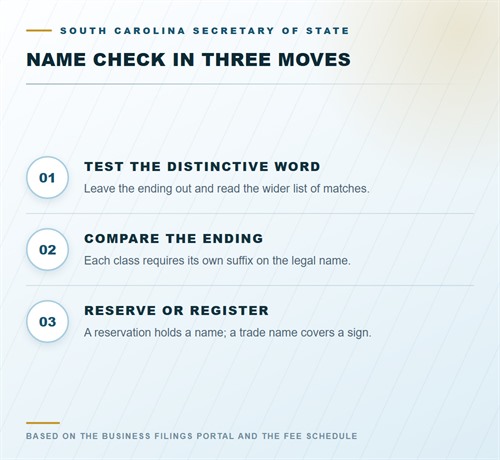
Choosing well begins with searching variants: spacing, abbreviations, punctuation, and the presence or absence of an ending. A title that looks free in one form may already be taken in another. The office compares names as they are recorded, so an organizer who checks only the exact spelling risks a rejection later in the process.
Reaching the Filing Office
The same portal lists the office address, 1205 Pendleton Street, Suite 525, Columbia, SC 29201, while 803-734-2158 reaches the division that handles name filings. Staff will not reserve a title over the telephone, but they will point to the document that does it. A call is useful before a formal submission rather than after one.
State of South Carolina, Business Entities Online, name index:
https://businessfilings.sc.gov/BusinessFiling/Entity/Search
Search Fields and Result Lists
The name field accepts a full title or a short fragment, and a fragment returns more rows than a complete title will. Entity type can be filtered, which helps when a word appears in several categories of filing. Nothing about the search is case sensitive, and punctuation tends to be disregarded on both sides of the comparison.
Anatomy of a Result Row
A result row carries the entity name, its type, its record number, and a status word. Similar titles appear next to each other, so the list itself is a useful signal about how crowded a particular word has become. Opening a row shows the documents on file and the dates attached to them, which is where a decision usually gets made.
Narrowing Long Result Lists
Long lists are best narrowed before they are read in detail. Adding a distinctive second word, changing the ending, or restricting the type filter will shorten the output. Saving a screenshot of a short list is not the same as a certified statement, and a bank or an agency may ask for the certificate instead. A note of which names were checked, and on what date, saves the same work later.
Distinguishable Names
Two names are distinguishable when the differences go beyond punctuation, capitalization, spacing, or a standard abbreviation. Adding the word the, changing a plural to a singular, or swapping LLC for Inc. will not separate one title from another in the office’s comparison. The test looks at how the names read rather than at how they are typed.
Words That Separate Titles
A genuinely different word does the work. Two companies may share a trade descriptor such as bakery or logistics, but they need something else that sets them apart. The office applies the same measure to a proposed name and to a name already held, and it does not weigh the size, reputation, or age of either business.
Borderline Wording Judgements
Judgement enters where the wording sits close to the line. A distinctive coined term, a surname combined with a service word, or a place reference plus an activity will usually clear. An organizer in doubt can file a reservation and learn the answer before spending more on a formation package, though the reservation itself must still meet the same standard.
Required Endings for Entity Names
A limited liability company must close its name with the words limited liability company or with the abbreviation LLC. A corporation must use incorporated, corporation, or one of their short forms, and a nonprofit corporation follows the corporate rule rather than the LLC rule. The ending is part of the legal name and appears on every later filing.
Marketing Names and Legal Titles
Dropping the ending to fit a sign or a website does not change the registered title, and a filing submitted without it will be returned. A business that prefers a shorter form for marketing can adopt a trade name for that purpose while keeping the full legal title on state documents. The two versions serve different functions and should not be confused.
Punctuation inside Abbreviations
Periods inside an abbreviation do not alter the comparison, so L.L.C. and LLC are read as the same ending. Spacing between letters is likewise ignored. What matters is that the ending appears at the close of the title, since a filing that buries it in the middle of a name will be returned for correction.
Restricted Words and Approval Requirements
Certain words suggest an activity the state supervises, and the office expects supporting documentation from the supervising agency before it accepts a filing that uses them. Bank, trust, insurance, and engineering belong to that group, along with wording that implies a professional license. The list is applied by the reviewer rather than published as a fixed table.
Titles Suggesting Government Links
Words that suggest a connection to government are a separate matter. A title that implies an agency, a department, or an official body will be refused unless the connection is real and documented. An organizer who wants a civic-sounding name should expect scrutiny and should be ready to justify the wording in the filing itself.
Gathering Approval Letters
Approval letters take time to obtain, and a reservation bought before the letter arrives may expire while the applicant waits. It is therefore sensible to gather the supporting document first and to submit the name filing once it is in hand. The reviewer needs the letter attached to the submission rather than promised later. A partial packet waits until the missing item arrives.
Reserving a Name for an LLC
A reservation holds a proposed company name while the organizer prepares the articles of organization. The reservation charge for a limited liability company is listed in the charges table further down, and it is paid at the time of submission. The reservation is recorded against the applicant rather than against a company that does not yet exist.
What a Reservation Holds
Holding a name does not create an entity. The articles must still be filed, accepted, and entered before the company exists, and the reservation simply keeps the title out of circulation for a limited period. The LLC search page describes the formation document and the filings that follow it. A reservation with no articles behind it therefore leaves the register unchanged.
Contents of the Reservation Record
The reservation record itself is brief: the applicant, the proposed title, the entity type, and the date the term ends. It carries no agent, no office, and no share structure, because no company exists yet. Anyone reading that entry should treat it as a placeholder rather than as a registration, and the status of the name on the public list stays as it was.
Reserving a Name for a Corporation
Corporate reservations follow a parallel procedure with a separate charge line, and the form asks for the applicant’s details along with the proposed title. A nonprofit applicant uses the corporate reservation as well. The reserved name must satisfy the same ending and distinguishability tests that apply to a live corporate record, and the applicant confirms that the title closes with a corporate designator.
Timing a Corporate Reservation
Timing matters when a formation package is assembled by several people. A reservation bought early in the process will usually still be in force by the time the articles are signed, while one bought months ahead may lapse first. The corporation search page covers the charter that follows a successful reservation. A lapsed date cannot be revived by sending the old form again.
Carrying the Title Forward
Once the articles are signed, the reserved title is carried over word for word. Changing punctuation or the ending at that stage turns the formation into a different name and can void the benefit of the reservation. Drafting the charter from the reserved text, rather than from memory, avoids that outcome. A reservation is worth nothing if the charter names something else.
Transfer of a Reserved Name
A reservation can be moved from one party to another through a transfer filing, which identifies the current holder, the new holder, and the name concerned. The charge for that document is listed with the other amounts below. Consent from the original applicant is part of the package, since the office will not reassign a name on an unsupported request.
When Transfers Are Needed
Transfers matter when a formation is reorganized, when a parent company takes over a project, or when the person who filed the reservation is not the person who will sign the articles. The transfer does not extend the reservation beyond its original term, and a name whose term has run out cannot be transferred at all.
How Transfers Are Recorded
Records of the transfer sit with the reservation itself, so the chain from the first holder to the current one stays visible to office staff. The public list continues to show a single reservation for the title rather than two competing entries. A later request about the name should therefore quote the original reservation reference.
Consent to Use an Indistinguishable Name
An applicant may ask to register a name that would otherwise be refused by submitting a written consent from the holder of the existing name. The office charges a separate amount for that application, shown below. Consent is voluntary, and the holder may attach conditions, though the office records only the fact of the agreement.
Contents of a Consent Letter
The route is used when related businesses want similar titles, or when a company changes its structure and wants to keep wording that another entity in the group already holds. Consent does not override the ending requirement or the restricted-word review. It addresses the conflict between two names and nothing else. A consent letter usually names both entities, both titles, and the signer’s authority, and a general expression of goodwill will not be accepted in its place.
Trade Names and the Entity Register
A business may advertise and trade under a name that differs from the one on its formation document. That trade name is not the legal name of the entity, and it is not what the register indexes when a search runs. A searcher who knows only the trade name may therefore need the legal title before a lookup succeeds.
Trade Names and Entity Names
That separation shows why a storefront sign and a state record can carry different words. It also shows why a trade name cannot be reserved through the entity process, since the reservation concerns a company title rather than a marketing label. A business that wants both protected should register the entity name and then manage the trade name under whatever rules apply to it.
Searching by Trade Name
Searches that begin with a trade name often fail for that reason, and a caller may be told no such business sits on the register. Pairing the marketing name with the town, the owner, or the agent can recover the legal title, and the agent lookup is sometimes the faster of the two routes. That work is done before a filing rather than after one.
Why a Name Filing Is Refused
Most refusals come from a conflict with an existing record, a missing or incorrect ending, a restricted word without supporting paperwork, or an incomplete form. The office returns the document with a notice rather than holding it in a queue, so the applicant learns the outcome soon after the review. A corrected filing can be submitted as a new document.
Reading a Refusal Notice
Some refusals are matters of reading rather than of substance. A name that differs only by a hyphen, an ampersand, or a trailing s will be treated as the same name. Others involve a word the reviewer considers misleading. In either case, the applicant can choose different wording, obtain consent, or supply the documentation the reviewer requested.
Resubmitting a Corrected Filing
Resubmission begins a new filing with a fresh date, and the earlier refusal stays in the office’s working records even though it never appears on the public file. A corrected document therefore needs to be complete on its face rather than a partial answer to the notice that came back. Reviewers look at the whole submission each time.
What a Name Search Cannot Confirm
The register does not report trademark rights, local licenses, domain registrations, or unregistered use of a name in commerce. A clean search therefore means that no entity on the state file holds the title, and nothing more. A business that invests in a brand should look beyond the entity index before printing materials. A federal register and a county license list are separate sources with their own search rules, each with its own fee and response time.
Limits of a Reservation
A reservation is likewise not a promise that the formation document will be accepted. The articles can fail for reasons unrelated to the name, including missing signatures or an incomplete agent section. The search and the reservation reduce one kind of risk, and the rest of the package carries the others. A returned document delays the whole project rather than only the title.
Business Judgement on Titles
Nor does the register say whether a title is wise to adopt. A name that clears every test can still be hard to spell, awkward on a sign, or close to a rival’s brand. Those are business questions, and the state file offers no view on them at all. Advisors and market research answer them, not a database query.
Name Filing Charges
Reservation, transfer, and consent requests are priced by statute, and the portal adds a separate state electronic records access charge when payment is submitted, on top of the scheduled figure. The search itself carries no charge at any hour, and searching is the one part of the process that never produces a bill. The table below sets out the figures for the name-related filings described above.
Charges by Entity Type
Reservation charges differ between entity types, and the transfer and consent documents sit on their own lines. A certificate of existence is included because a lender or a counterparty often asks for one alongside evidence of a name. None of these amounts depends on how long the name is or how many words it contains.
Combined Payments and Receipts
Payments for several name filings can be combined when the documents arrive in one packet, and the confirmation lists each item separately. Keeping that confirmation matters when a later question arises about which title was reserved, for whom, and on what date the term began to run. The office can trace a payment from that record alone.
| Item | Amount |
|---|---|
| LLC name reservation | $25 |
| Corporate reserved name | $10 |
| Transfer of a reserved name | $10 |
| Application to use an indistinguishable name | $10 |
| Business entity search | No charge |
| Certificate of existence | $10 |
Frequently Asked Questions
Questions about names usually concern cost, duration, and whether a search settles the matter. The replies below address those points for the state register as it operates today, and they apply equally to an organizer filing a first document and to a company adding a second entity to an existing group. Readers should confirm current practice with the office before filing, since forms, addresses, and statutory terms can change between legislative sessions.
Does a name search cost anything?
No. Searching the Business Entities portal is free and open at all hours, and no account is needed. Charges begin with filings such as a reservation, a transfer, or a request for a certified document from the office. Registration is neither offered nor needed, and a search can be repeated as often as the reader wishes.
How long does a reserved name stay available?
A reservation runs for a limited term set by statute, and the office records the expiration with the filing. The name returns to general availability once that term ends, so a formation should be completed before the date passes. The office notes that date on the reservation record, and a lapsed title cannot be revived.
Can a reservation be moved to another person?
Yes, through a transfer filing signed by the current holder. The document names both parties and the reserved title, and the office charges a set amount for it. The remaining term carries over rather than restarting, and the original reference number stays attached to the name. No second reservation is created, and the office keeps the original on file.
Does a reservation guarantee the articles will be accepted?
No. It protects the name for a period, and it does not certify that the formation document is complete or correct. The articles are reviewed on their own terms and can be returned for reasons that have nothing to do with the title. Signatures, the agent section, and the required ending each receive separate attention.
Must an LLC name include the letters LLC?
It must include either the full words limited liability company or the abbreviation LLC. A corporation uses incorporated, corporation, or a short form of one of those. The ending is part of the legal name on every filing. A missing ending sends a document back, and a shortened marketing version does not replace it on any state document.
Can two businesses register the same name?
Not without the holder’s written consent. An application to use an indistinguishable name allows the second registration when the first holder agrees, and the office charges a separate amount for that request. Consent does not waive the ending or restricted-word rules, and it covers only the titles named in the letter supplied with the application.