
A company’s status line is the shortest and most consequential entry in the South Carolina register. It records whether the entity is presently recognized, has been closed by its owners, or has lost recognition through state action. Lenders, landlords and suppliers check that field before committing money, because it decides whether an agreement signed by the company is backed by a recognized legal person.
The register is kept by the Secretary of State’s Business Filings division at 1205 Pendleton Street, Suite 525, Columbia, SC 29201, and searches cost nothing. Results can be printed or converted into a dated certificate when a third party demands formal proof. Reading a result correctly requires knowing which status words appear and what each implies about the capacity to act.
How a status word gets written into the register
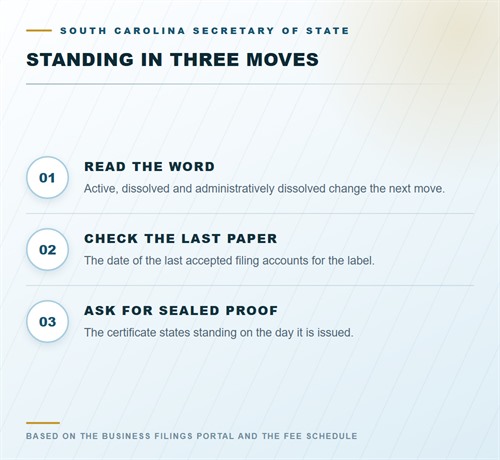
Status is not typed in by the filer. The division sets it when a filing is accepted, alters it when a dissolution order or administrative action is recorded, and displays it beside the file number and formation date. Three words account for most results: active, dissolved and administratively dissolved. Each carries different consequences for anyone signing, lending or suing. A reinstated entity keeps the same file number, so the history stays traceable through the gap.
The division assigns the value
Because the division maintains the field, a status result reflects what the office has processed rather than what the company believes about itself. A business that has voted to close but never filed the articles still shows as active. Conversely, a record can read dissolved while former managers continue to trade under the name, which is a compliance problem rather than a records error.
Where the word appears on a profile
Standing sits near the top of the entity page, above the registered agent line and the principal office address. A query by name returns the same word in the results table, so a reviewer can screen several candidates before opening any single file. The South Carolina company search interface shows this field without a login.
Current entity status and filing history are searchable through the state business filings portal:
https://businessfilings.sc.gov/BusinessFiling/Entity/Search
Reading an active result
An active entity is one the division currently recognizes as existing and authorized to conduct business in the state. Formation documents have been accepted, required appointments are current, and no closure or administrative order sits on the file. Active standing says nothing about solvency, payment record or management quality; it confirms only that the registration itself remains in force at the moment of the query.
Contracts and licenses that depend on standing
Many licenses, permits and professional registrations require the holder to stay active, and a lapse can suspend an approval issued by another agency. Contracts sometimes condition payment on continued existence, which turns a status change into a technical default. Reviewing the register before renewing a lease or a supply agreement catches that exposure early. The register shows registration, not approval by those bodies.
What active does not certify
The word appears even for a company with no assets, no insurance and no employees. It does not confirm that the business holds a local license, carries workers’ compensation coverage or files its taxes. Those questions belong to other agencies, and a diligent check pairs the register with the specific regulator for the industry involved.
Voluntary dissolution and its aftermath
When owners decide to close a company, they file articles of dissolution and the status changes to dissolved. That filing ends the entity’s existence for most purposes, although it may still be sued for a period afterward and must complete its wind-up. A dissolved company cannot enter new contracts or renew licenses in its own name.
Obligations that survive the filing
Dissolution does not extinguish debts, leases or pending claims. Assets must be applied to liabilities before anything is distributed to owners, and a distribution made prematurely can expose the recipients to recovery. Records should be retained, and notice to known creditors is part of an orderly wind-up. Notice is normally sent by mail to the addresses in the company’s own books.
Reviving a closed company
An entity that dissolved by choice can sometimes be restored, but the route differs from reinstatement after administrative action. The division expects a fresh filing and the appropriate charge, and the record then shows a new effective date rather than an unbroken history. Practitioners generally confirm the required documents with the division before submitting anything.
Administrative dissolution for lapsed compliance
The division may dissolve an entity administratively when a required filing or appointment lapses. The status then reads administratively dissolved, which signals state action rather than a decision by the owners. The company’s name can become available to others in some circumstances, and the entity loses the ability to enforce contracts or defend actions until the matter is corrected. Reinstatement does not erase the closure from the history; it adds a later entry.
How a lapse triggers the action
A registered agent who resigns without a successor, or an address that the division cannot use, can start the process. Notice goes to the address on file, which is often the same address that has already failed. The order is entered after the response period passes, and the public record changes without any further input from the company.
Name availability after a closure
Once an entity is administratively dissolved, its name may be released for use by another organizer. A former owner who intends to resume trading cannot assume the name remains reserved. Checking the register before ordering new signage or printing materials prevents a rejection at the filing counter and an avoidable rebrand. The published status changes when the order is entered, without further input from the owners.
Reinstatement and the tax compliance letter
Restoring an administratively dissolved entity requires an application for reinstatement together with the tax compliance letter that the Department of Revenue issues once account requirements are satisfied. Reinstatement after administrative dissolution is a statutory filing. When the division accepts the application, standing returns to active and the entity regains the capacity it held before the lapse, subject to conditions stated in the order.
What the compliance letter confirms
The letter states that the taxpayer’s account with the Department of Revenue is in order as of its issue date. It is obtained separately from the reinstatement application, so the two documents travel together in a single submission. An application filed without the letter is generally held or returned rather than approved. The letter is dated, and a recipient can compare that date with the date on the application.
Conditions written into the order
Reinstatement can be granted with conditions, such as a deadline for filing outstanding documents or correcting the agent record. The order may treat the restoration as retroactive, which affects contracts signed during the gap. Reading the full order matters, because the status word alone does not disclose those terms. A copy of the order belongs in the company record beside the original formation documents.
The certificate of existence as dated proof
A screen capture is convenient but rarely accepted for a closing, a loan file or a court submission. A certificate of existence is issued by the division, carries a date and states that the entity existed on that date. Banks and title companies normally require the document itself, and the South Carolina certificate of existence request is handled through the state office.
When a dated document is required
Transactions that close on a schedule need proof tied to a specific moment, because a printed search result carries no official date. Certificates are also requested for foreign qualification, licensing and banking onboarding. Some recipients insist on an issue date within a set window, so ordering early enough to avoid a stale document is part of planning the closing.
Certificates for names with no record
Where a search returns nothing, the division can issue a certificate of no record confirming that absence. That document serves underwriters, opposing counsel and trademark examiners who need evidence rather than a screenshot. It addresses the name only, and it does not speak to abandoned applications or unregistered trade usage. Requests go to the same office that issues certificates for entities already on the register.
Why limited liability companies file no annual report
Limited liability companies in South Carolina submit no annual report to the Secretary of State. The absence surprises owners who expect a recurring obligation, and it means an LLC can remain active for years without any periodic filing. Status changes for these entities therefore come from specific events rather than from a missed yearly return, which alters how a lapse typically begins.
What keeps an LLC record current
The agent appointment and the office address are the fields most likely to need attention, and both change by amendment. A company that moves, replaces its agent or changes managers may have nothing to file with the division at all. Owners should still confirm with the Department of Revenue whether a separate tax account filing applies to them.
Closure events for an LLC
An LLC ends by filing articles of termination or dissolution, depending on the statute that governs its formation. Until that filing is accepted, the register continues to show the company as active even if operations stopped months earlier. Buyers and lenders rely on the record, so an owner who winds down informally leaves a misleading file behind.
Corporate reporting runs through the Department of Revenue
Corporations follow a different path from limited liability companies. A corporation files the CL-1 initial report and later corporate returns with the South Carolina Department of Revenue, not with the Secretary of State. The two agencies keep separate systems, so a corporation can be current on its tax filings while its status record shows a problem, or the reverse.
The CL-1 report and later returns
The initial report is filed with the tax authority shortly after incorporation, and subsequent returns follow on the agency’s schedule. Because those documents never reach Business Filings, the entity profile will not show whether they were submitted. A reviewer who needs that answer must query the tax agency directly or ask the company for evidence.
Two registers, two answers
A clean status result and a delinquent tax account can coexist, as can the opposite combination, and both queries take only minutes to finish. Closing a transaction on the strength of one record alone leaves half the picture unseen. Where the deal is significant, both the corporate registration and the tax account deserve separate confirmation before funds change hands.
Screening a counterparty before signature
An agreement with a dissolved entity may be unenforceable against the party the signer believed existed. Before signing, a counterparty should confirm standing, verify that the agent’s office is genuine and establish that the individual holding the pen has authority. The division does not keep the names or addresses of officers or directors, so authority must come from the company’s own records.
Establishing authority to sign
Bylaws, an operating agreement or a resolution normally identify who may bind the company. None of those documents is filed with the state, which means the register cannot substitute for them. A signature block naming an officer proves little on its own, and independent confirmation of the signer’s role is standard practice in any substantial contract.
Records worth requesting
A buyer or lender typically asks for a certificate of existence, the formation documents and the current agent details. Together those items show that the entity exists, how it was organized and where official papers can be delivered, with originals preferred over scans. Gaps in that set are easier to resolve before signing than after a dispute has begun.
Matching names in a long result list
Ordinary words in a company name can produce a long list of near-duplicates. File numbers separate entities that share a name, and formation dates reveal which one is current. A search returning both a dissolved record and an active record with almost identical names usually reflects a reorganized business under a new filing rather than one company holding two states.
Telling a reorganization from a duplicate
Successor entities often keep the operating name while adding a suffix or a year to the registered form. Comparing formation dates and agent details distinguishes the live company from the retired one, and a retired file usually shows no agent activity after its closure date. Ordering the filing history of each candidate resolves the question faster than guessing from the name alone.
Names that cross state lines
A company registered in another state and qualified in South Carolina will show a certificate of authority rather than original formation documents. The home state’s record governs its internal affairs, while the South Carolina file covers the authority to do business locally. Both records can be active, and both may need checking for a single transaction.
What the register leaves out
Standing says nothing about insurance, professional licensing, tax compliance or ownership. A company can be active while a regulator elsewhere has suspended it from a licensed activity. A thorough review pairs the register result with the specific agency that governs the industry, and with the agent record that shows where official papers can actually be delivered.
Agencies outside Business Filings
Contractor licensing, health permits, alcohol licenses and insurance authority all sit with other bodies. None of those approvals appear on the entity profile, and a lapse there will not change the status word, since each body keeps its own definition of good standing. Screening a counterparty in a regulated field therefore requires a second query beyond the Secretary of State’s system.
Reading status beside agent information
Standing and the designated office answer different questions but are usually reviewed together. The South Carolina registered agent search shows who receives service and at which street address, which matters when a closed entity must still be located for a claim. Current agent details plus active standing is the combination that supports routine commercial dealing.
Locating a company that has closed
A dissolved entity may still be sued, and service has to reach a real place. If the agent resigned when the business closed, the plaintiff can serve the Secretary of State and rely on the address in the register. Confirming that address before filing saves a failed attempt and a refiled summons with its associated delay.
Charges for status records and certified documents
The search itself costs nothing, but certified documents and reinstatement filings carry statutory charges paid to the division. Certified copies are billed for the first page and again for each page beyond it, and a certificate confirming that no record exists carries its own amount. A separate state records access charge applies when an order is paid through the portal.
| Item | Amount |
|---|---|
| Business entity search | no charge |
| Certificate of existence | $10 |
| Certificate of no record | $20 |
| Reinstatement after administrative dissolution | $25 |
| Certified copy, initial page | $3 |
| Certified copy, further page | $0.50 |
Directing questions about a status result
Business Filings answers questions about recorded standing, filing history and document orders. The division works from its Columbia office and can be reached at 803-734-2158. Staff can describe what a record contains and how to correct an error, but they do not advise on the legal effect of a status change for a pending deal.
Frequently Asked Questions
These questions cover the situations that prompt most status inquiries at the filing counter and through the online portal. The answers describe the division’s current practice, and staff can confirm the details for a specific file number when a general rule does not settle the matter. Nothing here replaces the text of the statute or an order issued in a particular case.
What does administratively dissolved mean?
It means the division ended the registration through its own action rather than a filing by the owners, usually after a required appointment or document lapsed. The company must apply for reinstatement before it can operate as a recognized entity again.
Can a dissolved company still be sued?
Yes. Dissolution does not erase liability for conduct that occurred while the entity operated. Claims may proceed against the company and, in some circumstances, against those who received assets during wind-up.
Does active standing guarantee good credit?
No. The word confirms only that the registration is in force. Payment history, litigation and tax standing are separate matters held by other sources and are not reflected on the entity profile.
Does a limited liability company file every year?
No. A limited liability company has no yearly filing duty with the Secretary of State. The registration continues until a closure, an administrative action or a lapsed agent appointment alters the record, and none of those events follows a calendar.
Where do corporations submit annual returns?
A corporation sends the initial CL-1 and later returns to the Department of Revenue. The Secretary of State’s office handles formation and standing records, not the corporate income tax return.
How long does reinstatement take?
Timing depends on the completeness of the application and the compliance letter. Once the division accepts a correct submission, the record is updated and standing returns to active on the date shown.