

A corporation registered in South Carolina leaves a paper trail that begins with articles of incorporation and continues through amendments, mergers, and the periodic work handled by another agency. The Secretary of State keeps the entity file itself, while the Department of Revenue processes the returns that follow formation. Both strands matter to anyone checking a company before signing a contract.
The corporate record differs from an LLC record in its formation document, its fee schedule, and the officials named in the paperwork. It also differs in what the state collects and what it deliberately leaves out. The sections below move through the file in order, from the articles that create a corporation to the certificates that prove it exists on a given day.
The Corporate File at the State Office
Corporate filings are held by the South Carolina Secretary of State at 1205 Pendleton Street, Suite 525, Columbia, SC 29201. Questions about a document reach the Business Filings staff at 803-734-2158 during weekday hours. The division’s public portal supports a South Carolina company search that covers corporations, limited liability companies, nonprofits, and out-of-state registrations from one screen, and no account is required.
What a Result Page Shows
Each corporation receives a record number when its articles are accepted, and every later document joins that same file. The result page shows the entity name, the type, the status, and the date the file opened, followed by a list of accepted submissions. Images of the documents can be opened one at a time, and the earliest item is normally the formation paper itself.
Searching by Name or Number
Searches can be run by name or by record number, and a partial name returns a list rather than a single match. Generic words in company titles produce long lists, so adding a distinctive term narrows the field and shortens the review. Each row in the results links to the full file, and the office ignores punctuation in a search term, which helps when a title contains an ampersand.
Secretary of State, Business Entities Online, corporate filing history:
https://businessfilings.sc.gov/BusinessFiling/Entity/Search
Articles of Incorporation
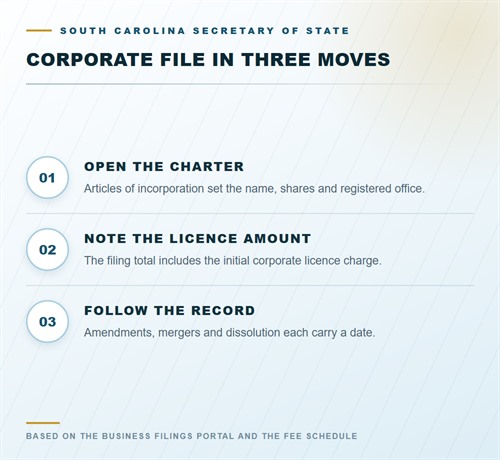
The articles of incorporation name the corporation, state the number of shares it may issue, and identify the registered agent and the office where that agent can be found. They also name the incorporator, who signs and delivers the document to the state. Acceptance marks the start of corporate existence, and the office returns a stamped copy for the company’s permanent records.
Articles for Nonprofits
A corporation that intends to operate as a nonprofit files different articles, which set out purpose language and the federal determinations the organization expects to seek. The office treats those filings as a separate category on the register, and the record shows the nonprofit designation beside the entity type. Both categories share the same numbering and the same history format.
Bylaws Kept off File
The articles do not describe day-to-day management, and they rarely name more than a handful of people. Bylaws fill in the internal rules after formation, and those rules stay with the corporation instead of entering the state file. A reader who expects the charter to read like a business plan will find something much shorter and more formal.
The Initial License Fee inside the Filing Total
The amount collected when articles of incorporation are accepted is not a single charge for paperwork. Part of the total is a license fee assessed at the start of corporate existence, and the office collects it together with the filing charge rather than billing it separately. The receipt shows a combined figure, so the two components are rarely named apart on the document.
Why Formation Costs Differ
That structure accounts for the gap between a corporate formation filing and an LLC formation filing of comparable length. The license component attaches to the privilege of operating as a corporation in the state, and it applies to business corporations rather than to the nonprofit category, which sits on a lower line of the schedule. Both amounts appear in the table near the end of this page.
Splitting the Formation Total
Requests for the exact split of a formation total should go to the Business Filings desk rather than being inferred from the receipt. Staff can confirm which portion covers the license and which covers the document itself. Payments made through the portal are itemized on the confirmation, and that record is the one a bookkeeper should keep for the corporate minute book.
Business and Nonprofit Corporations
Business corporations issue shares and exist to conduct trade, while nonprofit corporations are organized for purposes set by their articles and cannot distribute surplus to members. The state register uses one search interface for both, and the entity type field separates them in the results. Neither category escapes the agent requirement or the amendment process, and both pay the same charges for documents other than formation.
Changing Corporate Category
A nonprofit that later loses its federal exemption does not automatically change its state category, and a business corporation cannot become a nonprofit by amending a purpose clause. Conversions and mergers each take a separate filing. The entity type printed on the result page is the label that matters for the file, whatever the organization calls itself elsewhere.
Similar Names across Types
Names can overlap between the two categories, so a search on a familiar title may return a business corporation and a nonprofit with similar wording. The entity type filter settles which record belongs to which organization. Addresses and agents can coincide as well, since nothing prevents one professional service from representing many entities from a single office suite.
Officers and Directors outside the State File
The office keeps no list of a corporation’s officers or directors, and their addresses are absent from the file as well. Those details sit in the corporation’s own minute book and in the annual returns filed with the revenue department. A searcher looking for a president, a treasurer, or a board member will not find that list in the entity record, however complete the rest of the file appears.
Why the Gap Exists
The gap follows from the scope of the office rather than from an oversight. What the division indexes are the documents that create or alter the legal entity, and the identity of managers is not among the facts those documents must carry in this state. Requests for officer information belong with the company or with the agency that collects the returns.
Proof of Signing Authority
That distinction shapes how due diligence runs in practice. A lender confirming authority to sign may need a secretary’s certificate from the corporation rather than a printout from the portal. The state record can confirm existence, name, and status; it cannot confirm who holds office, and it should not be read as if it could.
Amendments and Mergers
Articles of amendment record changes to the corporate name, the share structure, the agent, or the office address. The filing restates the affected article instead of rewriting the whole charter, and the office attaches it to the existing history. Shareholders approve some amendments before filing, though the office itself does not review the internal vote. An amendment that changes the share count alters the charter itself, while an agent change touches only the contact details.
Effective Date of Changes
Amendments take effect on the date the office accepts them, and the earlier version of the article remains in the history as its own document. A reader who wants the current charter must apply each amendment in order rather than reading only the formation paper. That is why the document list deserves as much attention as the status field.
Mergers and Consolidations
Mergers combine two or more corporations into one surviving entity, and articles of merger identify which one continues. The surviving file receives the merger entry, and each disappearing corporation keeps its own record with the transaction noted. Consolidations follow a similar path, with a newly formed entity taking over the assets of the predecessors, and the office treats both routes the same way in the index.
Dissolution of a Corporation
A corporation ends its existence through articles of dissolution, which confirm that the business has wound up its affairs and distributed what remains. The filing closes the charter, and the register marks the entity as dissolved from the acceptance date. Creditors and courts look to the company’s own papers for anything beyond that registration event. The office does not audit the winding up, and it accepts the document on its face.
Lapses in Good Standing
Dissolution differs from a lapse in good standing, and the two conditions carry different status labels. A company that stops filing returns with the revenue department may still appear active at the Secretary of State, because the two agencies track separate obligations. Reading only one record can therefore give a misleading picture of the same business.
Companies That Never Traded
Some corporations dissolve without ever trading, and the file looks much the same as one that operated for decades. A short history of amendments or none at all is not evidence of a problem. What the register establishes is the sequence of filings, and the sequence ends when the dissolution paper is accepted. A reader should weigh that limit before drawing conclusions about the business behind the file.
Reinstatement after Administrative Dissolution
When a corporation falls out of compliance with the rules the office administers, the division may dissolve it by administrative action. The entry appears on the record with a date, and the corporation cannot lawfully transact business until its position is restored. A reinstatement application, submitted with the statutory charge, returns the entity to active status. Notice of the action goes to the agent of record, which is one reason a current office address matters.
Names Lost during a Gap
Restoration does not rewrite the past. The file retains the dissolution entry and the reinstatement entry in sequence, so a later reader sees exactly when the lapse began and ended. A name lost during the gap may require a change, since another business could have registered it meanwhile, and the application then carries the new name.
Timing a Reinstatement
Timing matters when a contract or a license renewal depends on active standing. A reinstatement accepted before a closing date clears the obstacle, while one accepted afterward leaves a gap on the record that a counterparty may question. The office updates the status as soon as the application clears, and the date of that change is what a later certificate reflects.
Foreign Corporate Authority
A corporation chartered outside this state that conducts business here files an application for a certificate of authority through the same portal. The application identifies the home state, the date of incorporation there, the agent, and the office address. Once authority is granted, the corporation appears in the same index as domestic entities and carries the same maintenance duties. A copy of the home state charter usually accompanies the application, and the office returns it with the certificate.
Assumed Names in State Filings
Foreign corporations file amendments when their agent or office changes, and they answer to the same status labels as domestic ones. A name already in use here forces registration under an assumed name for state purposes, while the home state charter keeps its original title. A withdrawal filing closes the registration when the corporation stops doing business in the state.
Which Name to File Under
The assumed name is recorded beside the corporate file, and correspondence from the office may cite either version. Filings should still be submitted under the registered name so staff can match them to the correct record. Where the corporation later abandons the assumed name, a separate filing ends its use without altering the charter, and the original title is unaffected by either submission.
Corporate Returns and the Revenue Department
The CL-1 initial annual report and later corporate returns go to the South Carolina Department of Revenue, not to the Secretary of State. That division of work surprises people who expect one agency to hold everything. A corporation’s tax filings and its entity filings therefore live in separate systems, and neither office can answer for the other’s records.
Two Agencies, Two Systems
Missing a return affects standing with the revenue department, while missing an entity filing affects standing with the Secretary of State. A company can be current in one system and behind in the other. Anyone verifying a corporation for a loan or a contract should check both, since the entity record alone shows only half the picture. The two checks take a few minutes each and can be run in either order.
Obtaining Tax Records
Copies of returns are not available from the Secretary of State, and the entity file never shows whether a payment reached the revenue department. A verification that begins with the portal and then moves to the tax agency covers both sides of the question. Requests for tax records follow that agency’s own disclosure rules and response times.
Certificates and Certified Copies
A certificate of existence states that a corporation is registered and in good standing on the date the office issues it. Banks, landlords, and out-of-state agencies often ask for one before a transaction closes. The certificate of existence page on this site describes the request, while the office itself issues the document in person, by mail, or online.
Certified Copies by Page
Certified copies of filed documents are a separate product. The office charges by the page, with a set amount for the first page and a smaller amount for each page after it, and the copy carries a certification stamp. A certificate of no record can also be ordered when a search finds no entity under a given name.
Comparing Corporate and LLC Filings
Both entity types share the agent rule, the designation of a street address, and the same public search. They part company on the formation paper, the initial charges, and the returns that follow. The LLC search page covers the limited liability side of the register, including articles of organization and termination filings. Each record keeps its own number, which makes a side-by-side comparison straightforward.
License Fee Distinctions
A corporation must also account for the license fee embedded in its formation total, which has no counterpart in an LLC filing. An LLC, in turn, has no equivalent of the share structure recorded in corporate articles. A reader comparing the two files should begin with those differences rather than with the status line, which looks alike on both.
Corporate Filing Fees
Amounts for corporate filings come from a statutory schedule, and the online portal applies a separate state electronic records access charge at the payment screen. The listed figure is therefore not always the final one at checkout. Payment by card produces an immediate receipt, and the table below lists the charges for the documents discussed on this page. The receipt should be kept with the corporation’s records for the tax year in which the payment falls.
Bundled Formation Charges
Formation charges bundle the initial license fee, so the figure for articles of incorporation exceeds the charge for an amendment by design. Nonprofit articles sit on a lower line of the schedule. Reinstatement, agent changes, and certificates each carry their own amount, and none of them depends on the size of the corporation or its annual revenue.
Ordering Certificates Together
Certificates ordered alongside a filing can be collected in one visit to the counter, which avoids a second trip. Mailed requests need the entity name and record number so staff can match them to the file, and the finished certificate returns by post. The two services are processed independently, so one does not delay the other.
| Item | Amount |
|---|---|
| Articles of incorporation (includes the $25 initial license fee) | $135 |
| Nonprofit articles of incorporation | $25 |
| Articles of amendment | $110 |
| Articles of merger | $110 |
| Foreign corporation certificate of authority | $135 |
| Reserved name | $10 |
| Certificate of existence | $10 |
| Certified copy of a filing, each extra page | $0.50 |
| Certified copy of a filing, first page | $3 |
| Change of agent or office | $10 |
| Reinstatement after administrative dissolution | $25 |
Frequently Asked Questions
Inquiries about corporate records usually concern the difference between the two state agencies, the contents of the charter, and what a status line really proves. The replies below draw on the filing rules the Business Filings division applies to every corporation on the register, whether the entity was formed last week or several decades ago.
Where does a corporation send the CL-1 report?
The CL-1 initial annual report goes to the South Carolina Department of Revenue with the corporation’s tax filing. The Secretary of State does not receive it and does not track it, so a review of the entity record reveals nothing about whether that report was submitted. Questions about the form belong with the revenue department.
Can a corporation’s officers be found in the state record?
No. Officer and director details are not collected by the division, and no field on the result page reports them. Those particulars stay with the corporation and appear on returns filed with the revenue department rather than with the Secretary of State. A minute book held by the corporation is the usual place to look.
What does a certificate of existence show?
It confirms current registration and good standing as of the issue date, and it names the entity and record number. It does not list officers, describe finances, or certify compliance with tax obligations handled by another agency. The document carries the office’s certification mark and the date on which it was produced by the office.
Is a dissolved corporation gone from the index?
The record remains searchable after dissolution, and every earlier document stays available. A searcher can see the dissolution entry and the filings that preceded it, which allows a later reader to reconstruct the corporate history without asking the office for a separate report. The name may pass to another business afterward, which is why the status matters.
Can an administratively dissolved corporation be restored?
Yes, through a reinstatement application filed with the statutory charge. The office returns the entity to active standing once the application is accepted, and the record then shows both the dissolution entry and the later reinstatement in date order. A name taken by another registrant in the meantime may have to change before the record clears.
Do nonprofit corporations file the same articles?
They file a nonprofit version of the articles, with purpose language and the federal exemption details the organization expects to pursue. The register marks the entity type accordingly, and the formation charge for that category sits below the business corporation figure. The remaining parts of the filing, including the agent section, follow the same path.