
A certificate of existence is a document issued by the South Carolina Secretary of State confirming that a business entity is authorized to transact business in the state on the date shown. Lending officers, landlords, and contracting parties may request one before approving an agreement. The paper reflects the public filing record at a single point in time.
Requests reach the agency through its online document service, by mail, or in person at the Columbia office. Each route produces a certified statement from the same records, though delivery time and handling differ. A requester should verify the entity name and identification number before sending payment, since the office prepares the certificate for the record it locates.
What the Certificate Proves
The document confirms that the named entity exists in the state filing system and remains authorized to do business as of the certification date. It shows the entity name and, when assigned, the identification number. A South Carolina company search can reveal the underlying record before a request is placed. The certificate does not assess solvency, tax compliance, ownership, or management quality; it reports only what the filing office holds.
The Public Filing Record
The certificate draws on the same database that supports the free online search. Filings appear after the office accepts and indexes them, so a document submitted on the same day may not yet be visible. A requester should allow time for processing before ordering a certificate that depends on a recent filing or a pending amendment.
South Carolina Secretary of State, Business Entities Online:
https://businessfilings.sc.gov/BusinessFiling/Entity/Search
Two Certificate Types
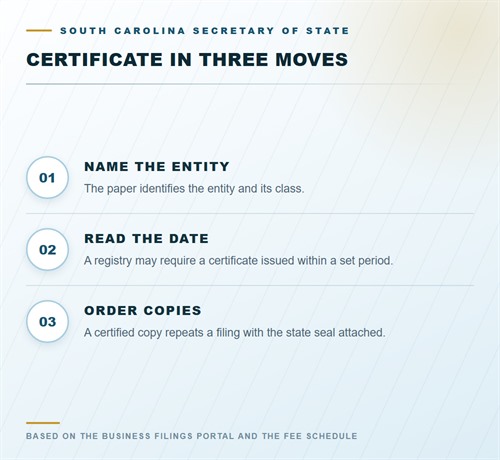
South Carolina issues separate papers for domestic and out-of-state entities. The distinction matters because the underlying filing differs, even though the application process and the statutory charge are alike. A domestic corporation, nonprofit, or limited liability company receives a certificate of existence. An entity formed under the laws of another state receives a certificate of authority when it is registered to do business in South Carolina.
Certificate of Existence for a Domestic Entity
This form is issued for an entity created by a filing with the South Carolina Secretary of State. It states that the entity is in existence and authorized to transact business. The record may show a corporation, a nonprofit corporation, a limited liability company, a limited partnership, or another recognized entity type. The certificate names the entity and gives the date of the certification.
Certificate of Authority for an Out-of-State Entity
An entity formed in another state must register before conducting business in South Carolina. Once registered, it may obtain a certificate of authority that confirms its registration is active. The paper is sometimes called a certificate of good standing, although the statutory label differs. It does not convert the entity into a South Carolina company or alter its governing law.
When a Lender or Landlord Asks
A financial institution may place a certificate in a loan file to confirm that the borrower is a valid entity at closing. A landlord may request the same paper before signing a commercial lease. Vendors and government agencies sometimes ask for proof during onboarding. The request usually comes with a deadline, so the entity should confirm its record is current before ordering the certificate.
Commercial Loan Files
Banks and credit unions use the certificate to verify the borrower’s legal name and active status. The document supports signature authority checks and helps the closing file show that the entity existed on the loan date. A lender may also ask for certified copies of formation documents or amendments. Those copies are separate products with their own charges.
Lease and Vendor Applications
A property manager may require a certificate before approving a tenant for office or retail space. Purchasing departments may request one from a supplier before issuing a contract. The certificate limits risk by showing that the entity is registered and active. It does not promise that the business will pay rent, perform work, or remain open.
The Online Document Request
The Secretary of State provides an online document request for certificates and copies. A requester selects the document type, identifies the entity, and sees the statutory charge plus a separate state electronic records access charge at checkout. The portal is an alternative to mailing a request or visiting the Columbia office. A requester should review the entity record and the order details before submitting payment.
Locating the Entity Record
The request begins with the legal name or the identification number assigned by the filing office. The filer should match the record carefully, because similar names can belong to different companies. The free business entity search shows basic filing details and the entity number. Correct identification reduces the chance of ordering a certificate for the wrong organization.
Checkout and the Records Charge
The checkout screen presents the statutory charge for the selected document together with the separate state electronic records access charge. A requester should compare that total with the fee schedule before completing the order. The order should identify the correct entity and document type so the certificate matches the transaction file. A copy of the order can be retained with the closing records.
The No-Record Certificate
When a search finds no filing for a name, the office may issue a certificate of no record. This paper states that no entity with the submitted name appears in the filing system on the search date. It is often needed in transactions where a party must show that a similar name does not belong to a registered business. The result depends on the exact name searched.
When No Filing Appears
A no-record result can occur because the name differs by a word, punctuation, or entity suffix. It can also occur when the business was never registered in South Carolina or the registration has been dissolved or withdrawn. A requester should check name variations and the identification number before relying on the result. The office reports its records, not the intentions of the parties.
Use in Closing Transactions
Title companies, lenders, and attorneys may request a no-record certificate during a closing before funds are disbursed. The document supports a statement that a particular name is clear in the state filing index. It does not resolve federal tax liens, court judgments, or filings held by other agencies. A separate search may be needed for those records.
Name Variations and Suffixes
A no-record result may change when the name is entered with a different suffix, spacing, or abbreviation. The office searches the name as submitted, so the requester controls the wording to some extent. Trying the entity number, a former name, or a shortened name can locate a record that the first attempt missed. A second search may be worthwhile before ordering a no-record paper.
Certified Copies and Plain Copies
Two copy products are available for filed documents. A certified copy carries a certification that the copy matches the record held by the office. A plain copy lacks that statement but still reproduces the filing. Both may be ordered online, by mail, or in person. The choice depends on whether the recipient requires an official certification.
What Certification Adds
Certification gives the recipient written assurance that the document was carefully compared with the official file. A court, bank, or licensing agency may require a certified copy for its records. The certified copy rate covers the first page and each separate additional page. A plain copy is usually sufficient for internal reference or informal review.
Page Charges for Longer Documents
Copy charges depend on length. The first page carries one rate and each additional page carries a lower rate, whether the copy is certified or plain. Long articles of incorporation or amendments can therefore cost more than a short certificate. A requester should estimate the page count before ordering several copies for a closing or filing.
Limits of the Certificate
The paper is not a license to operate every kind of business. Professional licensing boards, county business licenses, and state tax registrations sit outside the Secretary of State’s certificate. The document also says nothing about debts, lawsuits, or liens. A recipient should treat it as one item of evidence and request separate records for taxes, courts, and local permits.
Tax and Regulatory Standing
The certificate does not confirm that the entity has paid state taxes or filed required returns. Tax registration and payment are separate from the business entity filing record. A lender may require a tax clearance or a good standing letter from another office. The certificate covers only the state business entity filing record, not tax standing.
Ownership and Management
The certificate does not list or identify shareholders, members, managers, or officers. It does not prove who may legally sign a contract or bind the company. Ownership and authority are not established by the public business filing record alone. A recipient that needs those details must obtain the entity’s own documents or request a separate filing.
Licenses and Local Permits
Professional licensing boards and local business licenses operate outside the Secretary of State’s certificate. A regulated business may need approvals from other agencies before it can operate. The certificate does not verify those approvals. A business should contact the relevant licensing authority directly before relying on the certificate as proof of permission to advertise or serve customers.
Reading the Date on the Certificate
Every certificate carries a date, and that date defines the period covered. A certificate issued months earlier may no longer reflect the current status if the entity was dissolved, merged, or revoked. A recipient should check the age of the paper against its own requirements. Some closing checklists require a certificate dated within a recent window.
Changes After Issuance
An entity can file a dissolution, merger, or name change after the certificate is printed. The paper will not show the later event, because it speaks only to the earlier date. A recipient who needs current information should request a fresh certificate or check the online record. The office does not send automatic updates when a filing changes.
Delivery Delays
Processing time and mail delivery both affect the date a recipient sees. The certification date is the date the office issues the paper, regardless of when the recipient receives it. A closing schedule should allow enough time for the order to arrive before the closing. Courier arrangements may add cost without changing the certificate date at all.
Checking Business Status Online
A South Carolina business status search shows whether a record is active, inactive, or in another status. It also displays the entity number and basic filing data. The search can be completed before ordering a certificate, which helps confirm the exact legal name. The online record and the certificate should agree, since both come from the same filing system.
Active, Inactive, and Delinquent Labels
An active record generally means the entity is current with the filing office. A delinquent or inactive label may reflect a missed annual report, a revocation, or a voluntary dissolution. The certificate may still be available for an inactive entity in some situations, depending on the record. A requester should confirm the label before assuming the paper will satisfy a third party.
Name and Identification Number
The exact legal name on the certificate should match the name used in the transaction. Punctuation, abbreviations, and entity suffixes can create needless confusion. The identification number usually provides a more reliable match than a name alone. A requester should include the number on the application and compare it with the printed certificate after delivery.
Records for Dissolved Entities
A dissolved entity may still appear in the search results, with a status that shows the dissolution. The office may still issue a certificate that reflects the inactive record, depending on the filing status and document requested. A recipient should decide whether an inactive certificate meets its requirement or whether a different document, such as a court order, is needed.
Corporation Records and Name Checks
Corporations and limited liability companies appear in the state filing index. A South Carolina corporation search can show whether a proposed or existing name is already on file. The certificate itself does not reproduce entity records, but certified or plain copies can be ordered separately. Name checks are useful before a merger, rebranding, or new registration.
Articles and Amendments
Public formation documents and later amendments appear in the filing index. A free corporation search can confirm the current name and entity number. Those papers are not part of the certificate, although certified or plain copies can be ordered. A recipient that needs the complete filing history should request the relevant records and carefully review each amendment.
Mail and In-Person Requests
A written request may be mailed to the Secretary of State, Business Entities Online, 1205 Pendleton Street, Suite 525, Columbia, SC 29201. The envelope should include the entity name or number, the document requested, and payment. The Business Filings phone is 803-734-2158 for questions about the form. In-person requests are handled at the same Columbia address during office hours.
Mailing the Request
A mailed order should state whether the requester wants a certificate, a certified copy, or a plain copy. The entity name or identification number should appear on the request. A complete request reduces the chance of a delay. The requester should keep a copy of the letter and the payment record. Return delivery may take additional time beyond processing.
Visiting the Columbia Office
An in-person visit allows the requester to submit the form and payment at the office. The office is located at 1205 Pendleton Street, Suite 525, Columbia, SC 29201. A visitor should bring the entity name or identification number and the applicable fee. A complete request helps the office prepare the document without the need for a follow-up.
Details to Confirm Before Submitting
Accuracy at the request stage prevents delays and reorders. The legal name, entity number, document type, and copy count should be checked against the online record. A certificate for the wrong entity cannot be used to satisfy the intended recipient. The requester should also confirm the delivery address and whether an electronic or paper document is acceptable.
Entity Name Accuracy
A missing word or an incorrect suffix can send the request to a different record. The applicant should copy the name exactly as the filing office displays it. If the entity has changed its name, the current name should be used unless the recipient specifically needs the former name. The identification number remains the best cross-check.
Number of Copies
Closings, lenders, and landlords may each require a separate original. Ordering enough copies at the start avoids a second request and a second set of charges. A certified copy may be needed for one recipient while a plain copy serves another. The applicant should ask each recipient what type and how many pages are required.
Recipient Requirements
Each recipient may define what counts as acceptable proof. A bank might require a certificate dated within a set period, while a landlord might accept a recent online printout. The requester should obtain the exact requirement in writing before paying for a document that may be rejected. A short email from the recipient can prevent an unnecessary order.
Fee Schedule
The amounts below are set by statute and appear on the agency’s schedule. The online portal adds a separate state electronic records access charge at checkout, which is not part of the figures listed here. Copy charges depend on page count, and certification is included in the certified copy rate. A requester should review the total before submitting payment.
| Item | Amount |
|---|---|
| Certificate of existence | $10 |
| Certificate of authority | $10 |
| Certificate of no record or under seal | $20 |
| Certified copy, first page | $3 |
| Certified copy, each extra page | $0.50 |
| Plain copy, first page | $1 |
| Plain copy, each extra page | $0.50 |
Frequently Asked Questions
The answers below address routine questions about certificates, copies, and the filing record. They summarize the filing office’s published rules and do not replace the agency’s own instructions or a recipient’s requirements. A requester with a complex entity history, an unusual name, or a tight closing date should contact the Business Filings division for direction.
How long does a certificate remain valid?
The paper has no fixed expiration stated on its face. Its usefulness depends on the recipient’s rule, which may require a recent date. A certificate issued weeks or months earlier may be rejected for a closing.
Can a certificate be ordered for an inactive entity?
The office may issue a certificate for an entity whose record is inactive, depending on the filing status and the document requested. A recipient should confirm that an inactive status will satisfy the transaction before the order is placed.
Does the certificate prove tax compliance?
The certificate reflects the business entity filing record only. Tax registration and payment are separate matters handled outside that record, and a lender may require evidence of tax standing from another source.
What is the difference between a certified copy and a plain copy?
A certified copy includes a statement that it matches the official record. A plain copy reproduces the filing without that statement. Some courts and agencies require certification, while internal files may accept either form.
Can a request be submitted online?
Yes. The Secretary of State’s online document request accepts orders for certificates and copies. Payment is made through the portal, which includes a distinct state electronic records access charge at checkout.
What happens if the name search returns no record?
The office may issue a certificate of no record for the name searched. That result does not rule out a similar name, a former name, or a filing under a different entity type, so a second check may be warranted.