

A registered agent is the party that receives legal papers, tax notices and official correspondence on behalf of a business entity. The appointment is filed with the Secretary of State when the company is formed and appears on the public record together with the street address where the agent can be located. Any member of the public may inspect that entry without paying a charge.
The register keeps the agent lookup distinct from the entity lookup, so a query by name returns every organization that a given person or firm represents. That reversed view helps confirm whether an appointment was recorded and whether it still attaches to a company that has since been sold or restructured. The sections below describe the field, the qualification rules and the boundaries of state oversight.
Where the appointment sits in the record
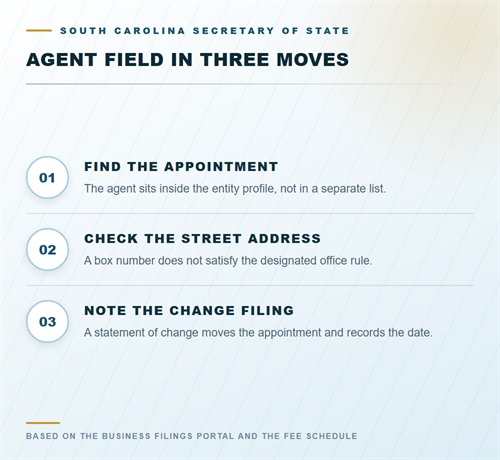
The appointment occupies a single line on the entity profile, printed beside the file number, the formation date and the current standing. It gives the agent’s name and the street address of the designated office. Nothing on that line shows when the appointment began, whether the agent has changed over the years, or how many other entities the same party represents. Detail of that kind appears only in the filing history or in an archived document order.
How the appointment enters the register at formation
Articles of organization and articles of incorporation each contain a section for naming the agent and stating the office address. The organizer completes that section, the division reviews it for completeness, and the accepted filing creates the entry that surfaces in South Carolina company search results. A submission listing a box number instead of a street location is returned to the filer for correction before acceptance. Abbreviated suite numbers and directional prefixes sometimes trigger a rejection as well.
What the profile leaves out
A viewer sees the current name and address, not the consent document, the date of appointment or the identity of any predecessor. When an entity has amended the appointment, earlier agents vanish from the profile and survive only through a document order. The omission matters in disputes that turn on who was authorized to accept papers on a specific date.
Entity filings and registered agent records are published by the Secretary of State’s Business Filings division:
https://businessfilings.sc.gov/BusinessFiling/Entity/Search
Who may hold the appointment
State law recognizes two categories of agent. The first is a natural person who resides in South Carolina. The second is a corporation, limited liability company or comparable organization that holds authority to transact business in the state. A nonresident individual cannot serve alone, and a foreign entity that has not obtained authority cannot serve at all until that authority is granted. A filer selects one category and supplies the details that match it.
Resident individuals who take the role
An owner living near the business often accepts the appointment to avoid a service retainer, and the arrangement works well while that person stays put. The individual must be reachable at the stated office during normal hours and willing to forward documents without delay. Someone who travels often or plans to relocate should consider naming an organization instead, since every move forces another amendment.
Organizations authorized in the state
A company that already holds a certificate of authority may act as agent for other entities. The practice is routine among incorporation services, law firms and accounting practices that keep a staffed reception area throughout the working week. Authority is checked against the same register that lists every other entity, so a lapsed authorization removes the legal basis for serving. Verifying that authority takes one query, and it is worth running before the consent is signed.
The street address requirement for the designated office
The designated office must be a physical location inside South Carolina rather than a mailing conduit. A post office box does not satisfy the office requirement, and a filing that lists only a box is treated as incomplete. The address has to be a place where a process server can appear in person and hand documents to somebody with authority to accept them.
Suites, shared premises and co-working desks
A suite inside a shared office building is acceptable when the agent truly receives mail there. Co-working arrangements differ widely, and some memberships supply a street address without any staff member who will sign for a hand delivery. An agent unable to guarantee that a person will take papers at the desk has not met the purpose of the appointment. Landlords who rent small suites often provide a mail slot but no one to accept a courier delivery.
Publication of the office address
The address is not shielded once a filing is accepted. Anyone running a query sees it, and data services copy it into their own listings within days of publication. Owners working from a residence should weigh that exposure before naming themselves, because removing the address later requires an amendment and a new appointment rather than a quiet edit. A separate mailing address for ordinary correspondence does not change what the register shows.
The agent lookup as a separate screen
The agent interface asks for a name instead of a file number, reversing the usual direction of a records query. It returns a table of entities with file numbers, formation dates and status words for each match. Broad surnames generate long lists, so a middle initial or a distinctive firm name shortens the result considerably and reduces guesswork about which entry belongs to the matter at hand.
Queries that produce reliable matches
Exact spelling counts for less than the sequence of names, though punctuation and suffixes can split a result into two. Searching a firm without its trailing company designation normally finds more records. Where a name returns nothing, checking the entity lookup by file number confirms whether the appointment sits under a variant spelling or a former name. Results also list entities that have been dissolved, so the standing column deserves a look before anything else.
Confirming an appointment before a closing
Counsel and title officers use the lookup to verify that the agent named in a purchase agreement matches the party in the register. A mismatch signals an amendment that was drafted but never filed. Pulling the entity profile during the same sitting shows whether the office address on the contract equals the address the state publishes. Saving a copy of the result with its print date keeps a record of what the register showed that day.
Commercial services against individual agents
Paid services sell continuity rather than legal standing. Their value lies in staffed desks, scanned mail and calendar reminders that reach an owner wherever that owner happens to be. An individual agent performs the identical legal function with no retainer, yet the arrangement depends on one person staying available, contactable and willing for as long as the entity continues to exist.
What a service contract tends to cover
Typical terms include receipt of mail, scanning to a portal, forwarding on request and notice when a filing deadline approaches. Some contracts bundle annual report handling or license renewal, although no state report exists for a limited liability company. Termination clauses deserve attention, because a service that stops mid-year leaves a gap only an amendment can close. Charges for extra services are usually quoted as separate line items rather than rolled into the base amount.
When self-appointment works well
A single-member company with a fixed office and predictable hours can usually name its owner without difficulty. The calculation shifts when that owner travels, rents space month to month or expects to move within a year. Each relocation means another amendment, and repeated amendments consume more time than a modest retainer would across the same span. Owners should also ask whether an incoming agent will accept a hand delivery on short notice.
Filing a change of agent or office
The entity, not the agent, files the change. A form identifies the company by name and file number, states the incoming agent and the new address, and carries that agent’s written consent. The outgoing agent’s signature is not always required. Once the division accepts the filing, the profile displays the replacement and the prior appointment stops being effective for service.
Consent from the incoming agent
Consent may appear as a signature on the amendment or as a separate statement kept with the filing. The division records that consent was supplied but does not telephone the new agent to confirm it. A company naming an agent without asking first may therefore hold a record that looks complete while the named party knows nothing about the role.
Electronic filing against paper delivery
Submission through Business Entities Online produces a confirmation number at once and usually refreshes the profile within a short period. Paper forms may be handed in at the Columbia office or sent by mail, which adds transit time to the same process. Both routes reach an identical statutory result, and the charge differs only by the portal’s separate records access line.
Resignation by the agent
An agent who wants out files a statement of resignation rather than simply stopping the work. The statement goes to the entity at its last known address and to the division, which then notes the vacancy on the record. For corporations the filing carries a small statutory charge. Resignation does not release the agent from duties tied to events that predate its effective date.
The vacancy that follows
Nothing in the register appoints a replacement automatically. The entity must submit an amendment, and until it does, the profile shows either a resigned agent or none at all. During that interval a plaintiff may serve the Secretary of State as substituted agent, and the company risks a default judgment if it never learns that a lawsuit exists.
Service of process routed through the office
When personal delivery at the designated office proves impossible, the Secretary of State may accept papers on the entity’s behalf. The office collects a fee for each instance and forwards the documents to the address on file. Service is complete once the state is served, regardless of whether the company ever opens the envelope that arrives later.
Why a stale office address creates risk
Forwarding depends on the address in the register, and the division does not hunt for a better one. A company that moved without amending its appointment will not receive notice, yet the judgment that follows remains valid and enforceable. Updating the office after a move is a defensive measure rather than a formality, and one filing completes it.
Keeping a home address out of the file
Owners who run a business from a residence often discover the exposure only after a customer looks up the company. The register is public, indexed by search engines and copied by commercial data providers. Once published, a residential address cannot be recalled. Appointing an agent with separate commercial premises at the outset avoids the problem and keeps the home out of later records.
What cannot be redacted
The division does not remove an address on request, and no confidential filing route exists for the agent field. A later amendment replaces the displayed entry, but archived document orders may still reproduce the older address on the forms themselves. Owners seeking full separation should appoint a service from the start rather than amend the record afterward.
Limits of state review
Acceptance of a filing confirms that the form was complete, not that its contents were accurate. The division does not verify residency, does not inspect the premises and does not test whether the agent will answer a knock at the door. Nor does it track whether one agent serves hundreds of entities from a single small suite. Accuracy stays with the filer.
Reliance by third parties
A lender reading only the register learns who was named, not who is functioning. Independent confirmation, such as a call to the listed office or a test delivery, closes part of that gap. For high-value transactions, counsel often requests a certificate alongside direct correspondence with the agent before closing on the purchase or the loan.
No inspection of the premises
The division has no field staff assigned to check whether a stated office exists, is staffed or is open during the hours claimed. Enforcement comes later, through complaints, failed service attempts or a filing that contradicts the record. A name and address in the system therefore mark a documented claim rather than an inspected fact.
Agent data read beside other records
The agent field answers a narrow question, and its usefulness grows when combined with the rest of the file. Formation date, file number and standing appear on the same profile, so a reviewer moves from the appointment to company history without leaving the system. Conflicts between a contract and the register usually surface during that comparison.
Checking a newly formed company end to end
A formation filing creates three records at once: the entity, its agent and its initial standing. Reviewers who examine all three catch clerical errors while correction remains inexpensive. Filtering the South Carolina LLC search by formation date narrows the field when the file number is unknown, and the agent lookup then confirms the appointment. A mismatch between the address on the articles and the one in the lookup usually points to a transcription error that is cheap to fix early.
Agent entries for limited liability companies
A limited liability company names its agent in the articles of organization and changes the appointment by amendment. Because no annual report reaches the Secretary of State, the field can stay untouched for a decade. That stillness is not evidence of abandonment; it reflects the absence of a recurring filing that would otherwise refresh the entry each year.
Signals that a company has gone quiet
Where an LLC has dissolved or lost its registration, the status field changes while the agent line may persist unchanged. A reader checking only the agent could conclude that the company still operates normally. Pairing the two fields is the dependable method, and a check through the South Carolina business status search also shows whether a reinstatement has been accepted since the closure.
Charges for agent filings and copies
Statutory amounts in South Carolina are fixed by law and collected by the Business Filings division. The table below lists the charges attached to agent changes, resignations and certified documents. Electronic orders placed through the portal carry an additional state records access charge at checkout, shown as its own line rather than folded into the statutory figure.
| Item | Amount |
|---|---|
| Change of agent or office | $10 |
| Agent’s statement of resignation | $3 |
| Service of process fee | $10 |
| Certificate of existence | $10 |
| Certified copy of an agent paper, first page | $3 |
| Certified copy of an agent paper, extra page | $0.50 |
| Business entity search | no charge |
Asking the division about an agent filing
Questions about a recorded appointment are handled by Business Filings at 1205 Pendleton Street, Suite 525, Columbia, SC 29201. The division’s telephone number is 803-734-2158. Staff can confirm whether an amendment was received and describe current form requirements, though they do not advise on whether a particular individual or firm should be appointed to the role.
Frequently Asked Questions
The questions below cover points that arise repeatedly when an appointment is filed, replaced or checked against the published record. Each answer describes the current practice of the Business Filings division, and staff can confirm details for a specific file number when a general answer is not enough to settle the matter. The answers summarize the published rule rather than any private arrangement between an entity and its agent.
Can a post office box serve as the designated office?
No. The designated office has to be a South Carolina street address where the agent can be found. A filing that lists only a box is incomplete and may be returned for correction or later amended.
Must the agent live in South Carolina?
An individual agent must reside in the state. A business entity may serve instead if it is authorized to transact business in South Carolina, which lets an out-of-state owner appoint a commercial service.
Is the office address visible to the public?
Yes. The agent name and office address appear on the entity profile and are returned by both the entity search and the agent lookup. No confidential option exists for that field, so a home address becomes part of the register.
How is a change of agent recorded?
The entity files an amendment naming the outgoing and incoming agents with the new office address. It may be submitted online or on paper, and the record updates after the division processes it.
What happens if no successor agent is named?
The record shows a resignation with no replacement. The entity then lacks a valid appointment, which allows substituted service on the Secretary of State and possible administrative action until a new filing arrives.
Can the division confirm that an agent agreed to serve?
The filing includes the agent’s consent, but the division does not contact that party to verify it. Accuracy rests with the filer, so a recorded name shows a form was submitted, not present willingness.