
South Carolina company search opens the business entity index that the Secretary of State keeps through Business Entities Online. The office registers corporations, nonprofit corporations, limited liability companies, limited partnerships, and limited liability partnerships, then publishes the resulting profile for anyone who needs to identify a business. The query runs against the current index rather than a periodic copy, so a filing accepted this week appears without a delay.
This page follows the search from the first query box to the sealed certificate, and it separates what the state file holds from what it does not. A reader checking a supplier, a landlord reviewing a tenant, a lender preparing a closing, or a founder confirming a filing will find the fields and the limits described here, together with the fee schedule the office applies to each document.
The Register Behind South Carolina Company Search
The register is a filing system, not a licensing system. An entity enters it by delivering a formation document and paying the statutory fee, and it stays there while the office holds a record for it. Every later paper that changes the name, the agent, the office, or the structure is added to the same file, which is why one profile can carry a long list of documents.
Who Files with the Office
Business corporations, nonprofit corporations, limited liability companies, and both partnership classes file here. Sole proprietorships and general partnerships do not, so a query for a corner shop trading under an owner’s name may return nothing at all. That absence is a fact about the filing system rather than a statement about whether the business exists.
The Free Query
The entity search costs nothing and needs no account. Money enters the process only when a document is filed or a copy is ordered, and the schedule later on this page lists those amounts. A reader can therefore run the same name through the index as often as a review demands without adding a cost to the file.
South Carolina Business Entities Online, entity search:
https://businessfilings.sc.gov/BusinessFiling/Entity/Search
Running a Query in Business Entities Online
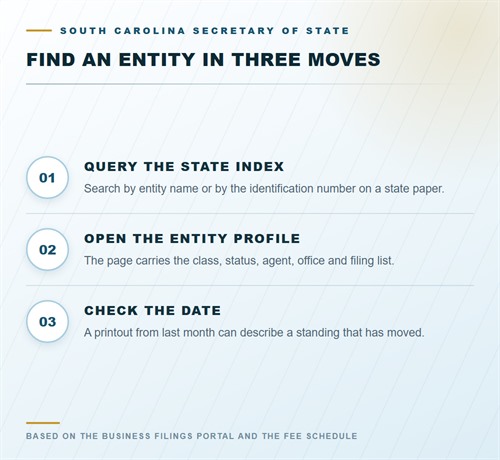
The search screen keeps the controls simple. One field takes the entity name and another takes the identification number, and the result table returns every record that fits the entry. The office does not ask the visitor to choose an entity class before searching, which means a single word can surface companies across several classes at once.
Search by Entity Name
A short fragment usually works better than a full legal name. The index stores the name as it was filed, so punctuation, a missing suffix, or an ampersand can change the list. Begin with the distinctive word, read the results, and narrow from there. A South Carolina LLC search often starts this way when the exact ending is uncertain.
Search by Identification Number
Every registered entity receives a number when the office accepts its formation paper. That number appears on certificates, annual notices, and receipts, and it reaches one file without the ambiguity of a name. A single mistyped digit returns an empty list rather than a near match, so compare the number with the paper before running the query.
Reading the Result Table
The table lists the entity name, the identification number, the class, the city, and the current status. A long list usually means the query word was broad rather than that the businesses are related. Sort by the status column first when the question concerns whether a company is still active, then open the profile that matches the address on the document in hand.
Fields on a South Carolina Entity Profile
An entity profile is short, and each block answers a separate question. The top carries the identity of the filer, the middle carries the standing and the addresses, and the bottom carries the documents the office accepted. Reading the blocks in that order keeps a reviewer from confusing a historical entry with a current fact.
Name and Entity Type
The legal name is the string on the formation document, not the sign above a door. A limited liability company must carry Limited Liability Company, LLC, or a recognized abbreviation, and a corporation must carry Corporation, Incorporated, Corp., or Inc. The class beside the name tells a reader which chapter of the code governs the file.
Status Line
The status line reports the office’s current view of the registration. It changes when a required paper is accepted, when an administrative action closes the file, or when a reinstatement returns it to the active list. The line is a compliance statement, and it says nothing about revenue, credit, or the quality of the business behind it.
Designated Office and Agent
The designated office is a South Carolina street address where a document can be delivered, and the registered agent is the party who accepts it. The two belong to one appointment. A commercial agent appears on many profiles, while a small company often names an owner or a lawyer, and both arrangements are permitted while the address rule is met.
Document List
The document list runs in the order the office processed the papers: formation, amendment, merger, change of agent, termination, and reinstatement. Each entry carries a document type and a date. A gap followed by a later filing describes an entity that returned to the register, not one that never left it.
Entity Classes in the State Index
One index holds several classes, and the class field is what separates them. The reporting duties, the formation paper, and the internal governance differ by class, so a reader who ignores the field can draw the wrong conclusion from a matching name. The profile always states the class in plain text near the top.
Limited Liability Companies
A limited liability company files articles of organization and may be managed by its members or by appointed managers. The public profile shows the company name, the agent, the office, and the filing history, but it does not list the members. An owner who needs to prove control relies on the operating agreement rather than on the state record.
Business and Nonprofit Corporations
A business corporation files articles of incorporation, while a nonprofit corporation files its own articles under a separate chapter. A South Carolina corporation search returns both classes in one list, and the class field distinguishes them. A nonprofit profile does not establish tax-exempt status, which is a determination made by the federal revenue authority rather than by the state filing office.
Foreign Registrations
An entity formed in another state registers in South Carolina before it transacts business here. The application names the home jurisdiction, the name used there, a local agent, and the office the company will use. The profile then shows the home state beside the local registration, and a reader can follow both.
What the Office Does Not Hold
The limits of the register matter as much as its contents. The Secretary of State’s Office states plainly that it does not have the names or addresses of a company’s officers or directors, and it does not publish member or shareholder lists. A reader who needs those facts has to look to the company, the revenue department, or a court file.
Officers and Directors
A corporate profile identifies the entity, not the people who run it. The office points readers to the Department of Revenue for officer and director information, and even that route depends on what the company reported on its returns. A contract that names an officer should be checked against the company’s own documents rather than the state index.
Owners and Shares
Ownership stays outside the public file for both companies and corporations. Members of an LLC and shareholders of a corporation are private parties unless a separate law requires disclosure. A buyer performing diligence asks the seller for the ownership schedule, and a lender conditions the loan on documents the borrower supplies rather than on the state profile.
The Agent Field and Service of Process
The agent is the person or company that receives legal papers for the entity. A lawsuit begins with delivery to that party at the designated office, and the office address must be a real location in South Carolina. The appointment is part of the public file, which is why a stale agent entry is a warning sign for anyone preparing to sign.
Who May Serve
A South Carolina resident individual may serve, and so may a business entity authorised to do business in the state. The agent signs a consent that travels with the appointment. A company that changes agents files a statement and pays the statutory charge, and the change takes effect when the office accepts the paper.
A Street Address Rule
A postal box is not accepted. The designated office must be a street address where service can be made during business hours, and the agent must be reachable there. A mailbox service that cannot accept a summons fails the same test, even when it holds a suite number in a commercial building.
Reading the Status Word
The status field is the first thing a counterparty checks, and it deserves a second look before any payment moves. The word describes the registration, not the business, and a company can trade while its file sits in a closed state. The date of the last accepted document is what turns the word into a usable fact.
Active Files
An active entity holds a registration in force at the office. A status lookup shows the word beside every result, and the profile adds the date of the last accepted paper. The label does not certify that the company is profitable, insured, or licensed for a particular trade, and it does not promise that the agent address is current. It means the file has not been closed by the office or by the owners at the time of the query.
Administrative Dissolution
The office may dissolve an entity administratively when a required fee or penalty goes unpaid and the notice period passes. The profile then shows the administrative action and the date. A contract signed after that point becomes awkward to enforce against the company, which is why a dated check before closing matters more than a printout from an earlier month.
Reinstatement
A company that lost its registration can apply to return. The application carries a statutory fee, and the office may ask for a tax compliance letter before it acts. The profile then shows the dissolution and the reinstatement as separate dates, so the gap remains visible to a later reader who reviews the file.
Annual Reporting in South Carolina
Reporting duties in South Carolina do not follow the pattern a reader may expect from other states. A limited liability company files no annual report with the Secretary of State, and a corporation sends its corporate returns to the Department of Revenue. The state register therefore shows filings that change the entity, not a yearly confirmation of its business.
LLC Reports
An LLC that is taxed as a pass-through entity has no annual filing at the Secretary of State. An LLC that elects corporate tax treatment falls under the revenue department’s corporate rules, which is a tax question rather than a registration question. A reader who sees no yearly entry on an LLC profile is seeing the normal pattern.
Corporate Returns
A corporation files an initial report with its formation papers and later files corporate returns with the Department of Revenue. Those returns carry the license fee that applies to corporate capital, and they do not appear as documents on the Secretary of State profile. The absence of a yearly entry on the state file is therefore expected for a corporation as well.
Names, Reservations, and Trade Names
A name is available when it is distinguishable from the names already on file and when it carries the ending its class requires. The search screen answers the first question, and the statutes answer the second. A reservation holds a name for a limited period while the formation paper is prepared, and it is optional rather than mandatory.
Reservation Filings
An LLC reserves a name with one filing, and a corporation reserves with another, and the two carry different statutory charges. A reserved name can be transferred to another party by a separate notice. A trade name registered by an existing business sits beside the legal name rather than replacing it, and the entity behind the sign remains the filer of record.
Certificates, Copies, and Sealed Paper
A certificate turns a search result into evidence that a bank, a landlord, or another registry will accept. The paper carries the office’s seal and states the standing of the entity on the day it is issued. A certified copy serves a different purpose, because it reproduces a filed document with the state’s certification attached to it.
Certificate of Existence
The certificate of existence, often called a certificate of good standing, confirms that the entity is on file and that its registration stands in the state. It does not list owners, and it does not certify a license or a tax account. A foreign registry may ask for the certificate within a stated age, so the issue date on the paper matters.
Certified and Plain Copies
A certified copy repeats a document already on file, such as articles or an amendment, and it carries a certificate page. A plain copy carries the same text without the seal and costs less. The request names the document and the filing date, and the office prices the order by the number of pages involved.
The UCC Index in Brief
The Secretary of State also serves as the central filing office for financing statements under the Uniform Commercial Code. That index is separate from the business entity register, and a company can appear in one without appearing in the other. A secured lender searches both when it needs a complete picture of a borrower’s obligations.
Financing Statements
A UCC-1 financing statement names the debtor, the secured party, and the collateral that secures an obligation. The filing perfects an interest in the collateral for a limited term, and a later amendment or continuation keeps the record alive. A UCC search returns the statements tied to the name that was searched.
Fees for Searches and Filings
The amounts below are the statutory charges the office publishes. The online portal adds a separate electronic records access charge at checkout, so a card payment can run above the statutory figure. A filer comparing the two routes should treat the difference as a portal charge rather than a change in the fee itself.
| Item | Amount |
|---|---|
| Business entity search | No charge |
| LLC articles of organization | $110 |
| Corporation articles of incorporation | $135, including the $25 initial license fee |
| LLC name reservation | $25 |
| Change of agent or office | $10 |
| Certificate of existence | $10 |
| Certified copy, opening page | $3 |
| Certified copy, added page | $0.50 |
| UCC-11 search | $5 |
Screening a Supplier or Tenant
A check before a payment starts with the register and then moves outward. Confirm that the name on the contract matches the legal name, that the status is active, and that the address on the invoice matches the agent or the designated office. A mismatch is not proof of fraud, but it is a reason to ask for a paper that ties the trading name to the entity.
Name Match
Compare the contract, the invoice, and the certificate line by line. A missing suffix or a different punctuation mark can signal a separate company with a similar name. When two records look alike, open both and compare the identification numbers. The number is the reliable link between a document and a profile.
Dated Evidence
A printout from last month describes the file as it stood on that day. Repeat the query on the day of signing, and order a certificate when a counterparty needs a sealed document. The date on the certificate is the fact a lender or a registry will rely on, and it costs far less to obtain than a dispute over a stale record.
Frequently Asked Questions
The answers below address the questions that arise most often when a reader opens a South Carolina business profile for the first time.
Is the South Carolina business search free?
Yes. The entity search opens without an account and charges nothing for a lookup. A charge begins with a filing or a copy request, and the free query can be repeated as often as a review requires.
Does the state file list company owners?
No. The Secretary of State publishes the entity, its class, its agent, its office, and its filings, but not its members or shareholders. Ownership records stay with the company and are produced in diligence rather than pulled from the register.
Where is the identification number printed?
It appears on the formation certificate, on office notices, and on a certificate of existence. Take the number from a state document rather than a directory, because one wrong digit sends the query to an empty result rather than a close match.
Do South Carolina LLCs file an annual report?
No. A limited liability company files no yearly report with the Secretary of State. A corporation reports to the Department of Revenue instead, so the state register does not show a yearly confirmation for either class of entity.
What does a certificate of existence show?
It is the office’s dated statement that the entity is registered and holds a current place on the file. Owners stay off the paper, and a business license or tax account is not certified.
Can a search use the registered agent name?
The office runs a separate agent search that returns the entities tied to a named agent. That route helps when the company name is uncertain, but the agent field reflects an appointment rather than ownership or control of the business.