
Limited liability companies make up a large share of the filings held by the South Carolina Secretary of State, and the public file for each one can be read online without charge through the Business Entities portal. That record is assembled from documents an organizer submits, later amendments and merger papers, and status entries added by the Business Filings division as filings arrive and take effect in the searchable index.
Reading an LLC file means knowing which documents create the record, which events change it, and which details never enter it at all. The sections below follow that order, from the articles of organization through amendments, termination, foreign registration, and reinstatement, with attention to the naming rule, the agent requirement, and the status vocabulary that apply to every company on the register, whatever its present standing may be. Each point rests on the office’s own filings.
The LLC File Held in Columbia
Formation records for South Carolina limited liability companies sit with the Secretary of State, Business Entities Online, at 1205 Pendleton Street, Suite 525, Columbia, SC 29201. Telephone 803-734-2158 reaches the Business Filings desk, where questions about a filing are answered during weekday hours. A free South Carolina company search at the state portal returns the record number, the entity name, the current status, and the filing history, while corporate, nonprofit, and foreign registrations fill the same index.
How the File Is Ordered
The office holds each file as a sequence of documents rather than as a narrative account of the business. Every accepted filing adds an entry carrying its own date, and the current status line sits at the top of the result page where a searcher sees it first. No member of staff writes a summary for the file, because the entries are the filed documents themselves, kept in the order received and tied to the record number.
South Carolina Secretary of State, Business Entities Online, company register:
https://businessfilings.sc.gov/BusinessFiling/Entity/Search
Articles of Organization
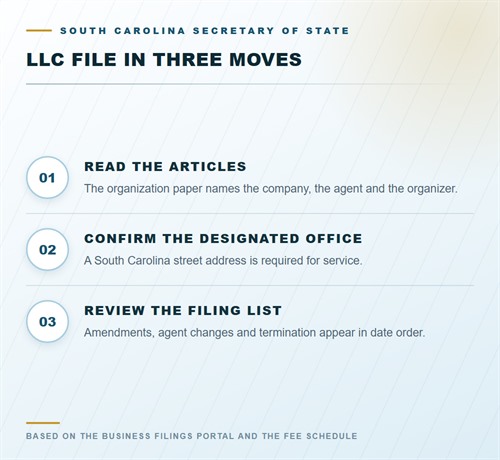
The articles of organization create the company on the register, and the paper itself is brief. It carries the LLC name, the registered agent and designated office, and a statement of whether members or managers direct the company. Once the office accepts the articles and records the receipt, the company exists as a South Carolina entity, and that date stays in a permanent record that later documents point back to. Rejection letters state the reason.
The Filing History in Order
Because the articles are short, most of what follows in the file consists of changes layered on that first document. A reader who opens the filing history sees the original articles, then any amendment, merger paper, or termination filed afterward, each with its own receipt date. The order of those entries gives the register its only chronology, since the office publishes no separate timeline for a company, and nothing is rearranged after acceptance.
Record Numbers and Receipts
Later documents are filed under the same record number rather than under a new company, so a searcher never has to guess which entry belongs to the business. The office stamps each submission with a date of receipt and a document number, and those references appear in the history exactly as issued. Nothing is combined or condensed when it enters the index, and a second copy of the same document, if filed twice, receives its own entry.
The LLC Name Rule
A company name on the register must end with a recognized LLC designation, either the words limited liability company or the abbreviation LLC, and it must differ from names already on file by more than punctuation or a minor variation. The office compares a proposed name against active records, and a filing that conflicts with an existing entry is rejected rather than held for later review. A reservation avoids that outcome and costs little.
Reserving a Title in Advance
Reserving a name in advance is an option for an organizer who is not ready to file articles. A reservation holds the name for a limited period while the formation document is prepared, and the statutory charge for an LLC reservation appears in the table near the end of this page. Moving a reservation to another party takes its own filing, and a reservation that lapses frees the name for anyone else to claim.
Transferring a Reserved Title
A reservation belongs to the applicant named on the request, and moving it to another party takes a separate filing rather than an informal handover. The document identifies the current holder, the incoming holder, and the title itself. The reserved name keeps the end date recorded on the original request, and the company’s formation follows the usual route afterward.
Designated Office and Registered Agent
Every LLC on the register names a registered agent who holds a South Carolina street address, called the designated office, where legal papers and official mail can be delivered in person during business hours. A post office box will not satisfy the rule. The agent may be an individual resident in the state or a business entity authorized to act in that capacity, and the same address serves both roles on the record.
Changing the Agent or Office
When the agent resigns or moves, or when the office address changes, the company files a statement of change and pays the statutory charge attached to that document. The office also runs a separate lookup that lists entities by agent name, found at https://businessfilings.sc.gov/BusinessFiling/Entity/AgentSearch, and a companion registered agent search page describes how those results are arranged. An agent’s resignation is filed by the agent, not the company.
Member-Managed and Manager-Managed Companies
The articles state which group holds authority: the members as a body, or one or more managers appointed for the purpose. That single election shapes how the company signs contracts, opens accounts, and records decisions, though the state file carries only the election itself and no account of the reasoning behind it. Both arrangements are accepted at formation without extra paperwork or a separate certificate.
Private Operating Agreements
An operating agreement governs the internal arrangement in detail, and it stays with the company rather than with the Secretary of State. Nothing in the public file records capital contributions, voting splits, or distribution terms, so a reader who needs those particulars asks the company directly or reviews records held at its principal place of business. That division of labor keeps the state file short and predictable for outside readers.
Switching Management Style
Neither choice is locked in permanently. A company that begins with member control can move authority to managers by filing an amendment that restates the election, and a manager-led company can return to member control the same way. The shift takes effect on the date the office accepts the document, so the amendment, rather than a private resolution, is what outside readers can see.
What the Record Shows and What It Omits
The register reports the entity name, record number, entity type, formation date, agent, and designated office, along with a status entry that reads active, dissolved, or administratively dissolved. Filing entries carry dates and document types. No annual report appears in an LLC file, because companies of this type do not file one with the Secretary of State at any point in their existence, and no office reminder is mailed for such a report.
Ownership Details Not Filed
Ownership and financial detail fall outside the file as well. Member names, percentage interests, profit splits, and balance sheets are not submitted with the articles, and no bureau collects them for a limited liability company of ordinary size. The register is a filing index, so a gap in it reflects the scope of the requirement rather than a lost document or a clerical failure. That distinction matters when a lender reviews a printout.
Reading Gaps in a File
A searcher comparing two companies therefore learns more from the filings than from the status field alone. One LLC may show years of amendments while another shows only its articles, and neither gap implies a problem. What the register can settle is whether a document was filed and when, which is the question most often put to it by outsiders. Judgements about credit, reputation, or conduct belong to other records entirely.
Amendments to the LLC File
An articles of amendment filing updates the record when the company changes its name, replaces its agent, moves its designated office, or alters the management election. The amendment arrives as a separate document that points to the original articles, and both stay visible in the history once the office accepts the change and enters it on the record. Old names remain searchable through the same page.
Mergers and Surviving Records
Mergers arrive through articles of merger, which name the surviving company and the entities combining into it. After acceptance, the surviving record continues with the new entry attached, while each absorbed company shows the merger on its own page. A reader tracing ownership across such a transaction follows both records rather than the survivor alone, since the absorbed entries keep their original dates and record numbers.
Articles of Termination
When the members wind up the business and settle its affairs, the company ends its registration by filing articles of termination. That document closes the record for purposes of doing business in the state, and the statutory charge for it is modest. The filing marks the point at which the entity stops operating as a registered company, and it follows the final distribution of assets.
Records after Winding Up
A terminated record does not disappear from the index. Searches still return the name, the record number, and the full sequence of filings, which matters to a lender, a purchaser, or a former contract partner checking what happened and when. Status wording separates a voluntary termination from an administrative action taken by the office on its own initiative, so the two outcomes never share a label.
What Termination Does Not End
Termination does not cancel debts, leases, or pending claims, and the office does not examine those matters before accepting the document. A searcher who finds a terminated record therefore reads it as a statement about registration rather than about solvency. Courts and creditors look to the company’s own papers, and to any later legal action, for the rest of the story.
Termination Compared with Dissolution
The register separates a voluntary end from an administrative one. A company that files termination papers chooses the date its registration closes, while one dissolved by the office loses standing through a lapse in a statutory requirement. Both outcomes leave the name searchable, and the result page reports either one in a single status field.
Foreign LLC Registration
A limited liability company formed in another state that transacts business in South Carolina applies for a certificate of authority before it opens operations here. The application identifies the home state, the home state record number, the agent, and the designated office, and the office issues authority once the paperwork and the statutory charge are in order. A copy of the home state filing usually accompanies it.
Assumed Names for Foreign Firms
Once registered, a foreign company follows the same maintenance rules as a domestic one, filing amendments when its agent or office changes and answering to the same status vocabulary. If its name is already taken here, it registers under an assumed name for use within the state while keeping the original name on the home state record. Registration does not create a new company or change its home state charter.
Reinstatement after Administrative Dissolution
The office may dissolve a company administratively when a statutory requirement lapses, with a vacant agent position among the usual triggers. The status line then reads administratively dissolved, and the company loses authority to do business until the matter is corrected through a reinstatement application that returns the record to active standing. Nothing about the company’s contracts changes automatically when the status shifts.
Name Conflicts during Reinstatement
Reinstatement is a filing rather than a conversation, and the office publishes the charge in its schedule of fees. Name conflicts can complicate the process, because a company that lost its name to a later registrant may need to adopt a different one as part of the application. Records showing administrative dissolution stay visible even after the status changes, so the gap in standing never disappears.
History of the Gap
Filing the application does not erase the earlier history, and the record keeps both the dissolution entry and the reinstatement entry in date order. Anyone reviewing the company later sees the gap in standing and the reason for it, which may be as simple as an agent vacancy that went unnoticed for a season, or a statement of change that never reached the office.
Comparing LLC and Corporate Records
Corporations appear in the same index but carry a different formation document, a different fee schedule, and different ongoing obligations. A corporate file begins with articles of incorporation, and its owners hold shares rather than membership interests. The corporation search page sets out those differences at length, including the returns that go to another agency instead of the Secretary of State.
Shared Rules and Certificates
Both entity types share the agent requirement, the designated office rule, and the certificate services offered by the office. Both also use the same status vocabulary, so a result for either type reads the same way once the searcher knows which document opened the file. Divergence shows up in fees and in what each type must file afterward, which is where a comparison usually starts.
Reading a Search Result
A result page leads with the entity name and status, then lists the record number, the entity type, and the formation date. Filing entries follow in date order, each with a document type that can be opened as an image. A searcher who needs a certified statement for a bank or a court orders one from the office instead of relying on a screen capture of the page.
Liens Outside the Entity File
Security interest records kept under commercial code filings sit in a separate index and never appear on the entity page, so a clean result does not prove that no lien exists. Cross-checking the agent lookup against the filing history gives a fuller picture than the status line alone, particularly for a company that has changed hands or names in the past few years.
Certified Statements and Printouts
Printouts of a result page carry no seal, and staff at a bank or a registry may decline them. A certificate of existence, ordered from the same office, states the current status and the date it was confirmed, and it travels better than a page saved from a browser. Copies of individual filings can likewise be certified on request.
Filing Fees for LLC Paperwork
Charges for LLC filings follow a statutory schedule, and the portal applies a further state electronic records access charge when payment is made, on top of the listed figure. Payment is made by card during the transaction, and a receipt appears in the confirmation message. The table below sets out the amounts for the filings described above, including certificates and copies. Those figures change only when the legislature amends the schedule.
Charges Attach to Documents
Fees attach to the document rather than to the calendar, so a company that files nothing during a year owes nothing to the Secretary of State. Certified copies carry their own schedule, and a certificate of no record can be requested when a search returns nothing. Requests submitted in person or by mail follow the same published amounts, and the office quotes them on request.
Short Forms and Packets
Several documents on the schedule are short statements rather than full filings, and their charges reflect that. A change of agent, a transfer of a reserved name, or an article of termination each takes a brief form. The office accepts payment for a group of filings submitted together, provided every document is identified on the request.
| Item | Amount |
|---|---|
| Articles of organization | $110 |
| Articles of amendment | $110 |
| Articles of merger | $110 |
| Foreign LLC certificate of authority | $110 |
| Name reservation | $25 |
| Transfer of a reserved name | $10 |
| Change of agent or office | $10 |
| Articles of termination | $10 |
| Reinstatement after administrative dissolution | $25 |
| Certificate of existence | $10 |
| Certified paper copy, first page | $3 |
| Certified paper copy, each extra page | $0.50 |
Frequently Asked Questions
Questions about LLC records tend to cluster around status, access, and the boundary between a state filing and a private agreement. The answers below address the points raised most often by searchers reviewing a company before a contract, a loan, or a purchase, and each response reflects the practice of the Business Filings division rather than a general rule applied elsewhere.
Does a South Carolina LLC file an annual report?
No. Limited liability companies do not submit an annual report to the Secretary of State, and no periodic filing keeps an LLC in good standing with that office. Changes in standing come from amendments, statements of change, termination papers, or an administrative action taken by the division. A reminder letter is not part of the process either.
What does the status active mean on a result page?
Active means the company is currently registered and has not been dissolved, terminated, or removed from the register. It reflects the filing record alone and says nothing about taxes owed, licenses held, or whether the business is still trading under that name. A certificate ordered on the same day repeats the same word and date.
Can an LLC record be viewed without paying a fee?
Yes. Basic lookups through Business Entities Online cost nothing, and the record number, status, and document list can be read at any hour. Charges apply only when a certificate, a certified copy, or a specific filing is requested from the office. No registration is needed to browse, and repeat searches carry no limit at all.
How is a registered agent shown in the file?
The agent’s name and the designated office address appear on the result page and in the formation document. A change of agent or office is recorded as its own filing, with a date, so the current entry is always the most recent one accepted. Older agent details remain in the history beside the newer entry.
What happens to the record after termination?
The file stays in the index indefinitely, with every prior document still available. Searchers can see the termination entry alongside the original articles, which allows a later reader to reconstruct the sequence of events without contacting the office for a separate history. The status word changes at the close, but the underlying documents themselves do not.
Does the state file list the owners of an LLC?
Ownership is not part of the public record. Member names, percentages, and contribution amounts stay in private company records, and the Secretary of State neither collects nor publishes them for a limited liability company formed under state law. A certificate of existence does not add them, and the filing history leaves the same gap in every case.